
Talismans and Oracles: The Question of Religiousness in Japan
From devout participation to cultural tapestry, religiousness in Japan requires a nuanced understanding—one accounting for the purchasing of talismans, objects, and divine protection.

When you think of Japanese religion, what comes to mind? The intrinsic connection and deep-rooted appreciation of nature found in Shinto beliefs? Practitioners spiritually invested in zazen meditation and mindfulness, aware of the profoundly transient nature of life and existence, as taught in the Buddhist scriptures? Everyday people navigating today’s technocratic world of stark rationality, economic calculability, and workplace pressure, guided by ancient wisdom?
Yet, when visiting Buddhist temples and Shinto shrines, only a few visitors will be able to witness visible examples of sincerely devout faith, such as groups immersed in the quiet concentration of zazen meditation or pious Pure Land devotees chanting the formula Namu Amidabutsu, the sound resonating around the hall.
Rather, what one will see most is people ringing the suzu bells in front of Shinto altars, clapping their hands, tossing coins into the large donation boxes, and praying to the kami (Shinto deities), buddhas, and other figures; high school students frantically offering prayers to the god Tenjin (the deified scholar Sugawara no Michizane) or whoever they believe may help them achieve good grades in their examinations; childbearing mothers buying lucky charms (omamori) to secure the birth of a healthy child; travelers writing their everyday hopes and wishes for good luck on small, wooden votive ema plaques; or even car owners buying talismans to protect their rides from any potential accidents.
Religion in Japan is complex and often differs from Western expectations. Many practices revolve around transactions of fortune and prayers, motivated by everyday needs and desires, and do not necessarily require a profound commitment or faith–a cultural perspective, rather than a faith-based framework.
Omamori, Ofuda, Omikuji: Objects of Fate and Fortune
All Shinto and Buddhist sites, no matter how small they may be, are regularly equipped with booths selling a variety of talismans, charms, auspicious objects, and oracle slots. Particularly efficacious items not only aim to increase the worshipper’s fortune, but also boost the image (and income) of the religious institutions selling them. Quite different from what most people might expect, this is the more authentic depiction of Japanese religion seen at temples, shrines, and monasteries.
Amulets and talismans are thought to provide protection and attract good fortune; those safeguarding a larger, locally confined community (such as a household or a neighborhood) are called ofuda, while those focusing on individuals are called omamori. Often rectangular in shape, the power of these talismans is thought to derive from the words printed on them, most often phrases or names derived from Buddhist scriptures or other sacred texts. Other omamori display a particularly powerful object venerated at the shrine, like swords or arrows, while in some cases, animals associated with the specific site may be depicted, such as the piercing gaze of Inari’s foxes.
Beyond seeking protection and blessings, temple and shrine visitors typically write their wishes and create votive tablets, such as ema, which are then displayed on the grounds. Esoteric Buddhism and Shugendo (the religion of mountain ascetics that blends esoteric Buddhism, Shinto, and Chinese Daoism) employ similar practices, with practitioners writing wishes on logs called gomagi. Based on the ancient Indian Vedic votive ritual homa, the logs are ritually burned, accompanied by esoteric Buddhist chants and the enigmatic beating of drums.
While the future that fate holds may be murky, many temples and shrines offer a way to glimpse ahead through omikuji oracle strips. After grabbing a bamboo stick at random from an overflowing box, visitors can attempt to divine their fortune, as each stick is marked with a symbol linking to a specific divination strip. Often vague and categorizing one’s future along a spectrum of “great luck” (daikichi) to “great misfortune” (daikyo), if the message holds misfortune, people will fold the strip and attach it to a tree at the shrine or temple, as if to tie away their bad fortune for some higher being to handle instead. There are, however, diverse practices depending on the locality.

Purchasing a Prayer: Additional Spiritual Objects
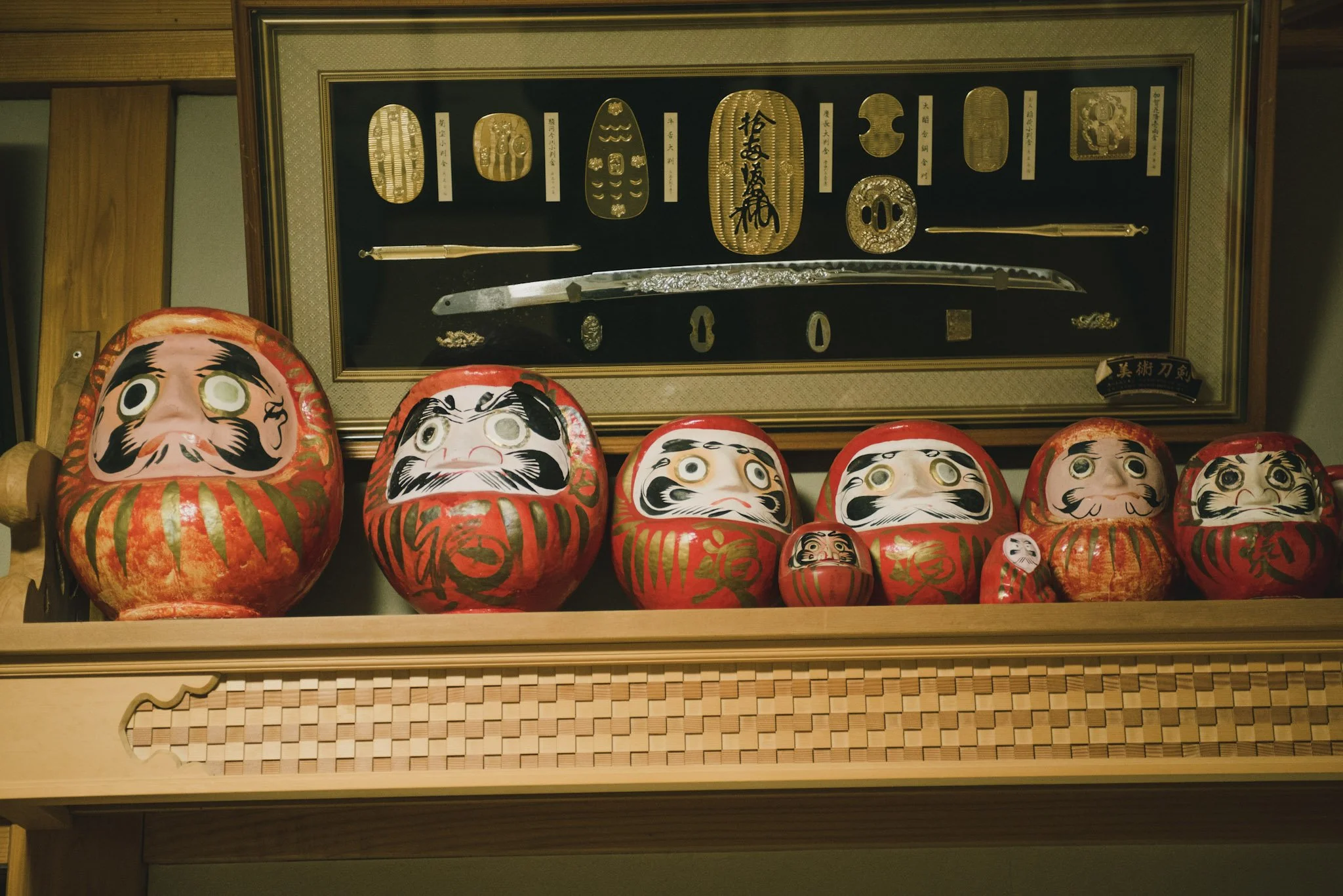
Japanese temples and shrines sell a variety of objects beyond those tied to fate and fortune, collectively called engimono. Literally referring to objects that create a special karmic bond between the object and the buyer (a practice called kechien), the term ultimately refers to all kinds of lucky objects that represent the presence of a kami, buddha, or bodhisattva (enlightened being). One of the best-known engimono is the Daruma doll, a stylized representation of Bodhidharma, the legendary (and most likely fictitious) founder of the Zen (Chan in Chinese) tradition in sixth-century China, at the famed Shaolin Monastery. Another one is the maneki neko, the famous beckoning cat, which is widely popular not only in Japan but also all across the world.
Many templegoers, especially pilgrims, eagerly collect goshuin from the religious sites they visit. Vermillion seals accompanied by handwritten script providing details about the temple or shrine, as well as the date of one’s visit, these stamps are collected in special books, or occasionally printed on cloth, to document one’s visit.
A practice dating back to the thirteenth century, goshuin were used as payment receipts by solitary Buddhist hijiri wanderers to prove their dedication of a sutra to a particular place. During the Edo period, goshuin further evolved, with the term itself originally referring to the Shogun’s seal. However, only from the early twentieth century onwards was it codified to become the practice's standard designation. Yet far from being mere stamps and visualizations of temple visits, goshuin are also used for talismanic purposes, thought to represent a deep karmic bond. For many people, however, goshuin just serve to visualize their travels–a desire perhaps also explaining why many train stations across Japan now offer their own distinctive stamps for travelers to collect.
While items like goshuin or daruma dolls can be purchased any time of the year, other practices are connected directly to the calendar. On New Year’s Day, hundreds of thousands of Japanese flock to local shrines, a custom called hatsumode (“first visit”), to get rid of the old talismans and to purchase new ones. Cynics may interpret the claim to need to buy new talismans every year as merely a smart idea to create some sort of “customer loyalty,” but there is much more to it than just business–the cyclic pattern of exchange between individuals and religious institutions also embodies renewal, gratitude, and reciprocity.
Whether cherished as souvenirs or treasured as symbols of faith and fortune, these objects continue to connect people to Japan’s spiritual landscape—not by requiring reverent religious beliefs, but by sheer participation through purchasing.
Religion, Not Religious
Despite their spiritual origins, these kinds of activities, which arguably constitute the majority of how Japanese people experience religion in temples, shrines, and monasteries, always involve a transaction of money–an operation flouting most Western expectations of Japanese religiosity.
For most templegoers, these are fairly straightforward transactions with deities, buddhas, and bodhisattvas, where money is traded for security, health, well-being, and good luck. And, more often than not, it’s simply just that–no profound feeling of faithfulness or devotion required. Simply doing it suffices.
Employing the well-established Buddhist phrase genze riyaku (literally, “benefits in this world”), Ian Reader and George Tanabe have argued in their famous book that the Japanese are “practically religious.” They claim that, regardless of religion, the common denominator of Japanese engagement with religion is seeking just that–worldly benefits. This doesn’t mean practitioners only focus on tangible things, such as material wellbeing or physical health. Rather, Reader and Tanabe explain Japanese approaches to religion as a means to directly improve living circumstances, seeking not just material support, but also freedom from anxiety and uncertainty.
According to this understanding, most Japanese religions focus on the here and now, and people usually don’t seek to obtain salvationist benefits in a future life or in the afterlife, a perspective often thought to be one of the major reasons why Christianity in Japan is still a minority religion, practiced by approximately only 1% of the population.
Yet focusing on the here and now is only part of the story.
Even more striking is that polls and social surveys conducted over the past decades have shown that most individuals don’t even believe in what they’re doing. Many Japanese express their attitude towards religion and religious practices by using the phrase hanshin hangi, “partly believe, partly doubt.” A survey conducted in 1983 showed that only 16.8% of those who regularly bought omamori actually believed them to be efficacious. Similarly, the 2007 Health and Faith Survey data reported that nearly half of the respondents (49%) stated they didn’t really believe, yet still performed rituals.
All of this stands in stark contrast to official statistics from the Agency of Cultural Affairs, which typically claim about 100 million believers of Buddhism and Shinto each, simply because most people are simultaneously affiliated with both a local Buddhist and a Shinto site. More often than not, however, people are associated with a Buddhist temple simply because their ancestors are buried there, telling little about personal attitudes toward Buddhism. Data from the Japanese General Social Surveys from 2000 to 2005 suggest that only 11% of respondents claimed to personally believe in the religion with which they are affiliated. Similarly, in a follow-up survey, only 2.5% of respondents claimed to be highly devoted to their religion, while 71% stated they are not devoted at all, despite their affiliation.

Defining Faith in Japan
Although these findings seem to contradict the abundance of practices and purchases at temples and shrines, the issue ultimately boils down to the question of what one understands as “religion.” Most Japanese frame their actions as elements of Japanese culture and tradition, not faith. For them, being religious means devoting one’s entire life to one’s faith and strongly identifying with it, which most people don’t.
It’s no coincidence that this perspective is remarkably similar to the Western concept of religion, as the Japanese term for religion, shukyo, is a modern invention created in the second half of the nineteenth century by Japanese intellectuals and politicians to translate a Western word and concept. Based on the Christian default model, shukyo is now seen as an expression of profound faith in a set of canonized scriptures, clearly delineated beliefs and values, and bound together by a recognizable religious institution (such as churches and temples).
Of course, faith (shinko in Japanese) is also often stressed in religious scriptures and sermons. For instance, one major Buddhist denomination, the “True School of the Pure Land” (Jodo shinshu)–established by the charismatic priest Shinran in the thirteenth century and based on the idea that everyone can be reborn into Amitabha Buddha’s “Pure Land” as long as they wholeheartedly recites the name of this buddha–highlights the significance of deep, sincere belief (shinjin) in one’s spiritual quest towards salvation.
However, as survey data suggests, this kind of faith doesn’t seem to play a role in the lives of most practitioners–even those of the Jodo shinshu. As baffling as it may sound, it’s no different from casual Sunday churchgoers in the US who might attend church to join prayer sessions for family tradition, social expectations, or simply to enjoy the company of friends and neighbors.

Although relatively few Japanese identify strongly with a particular religion, there is good reason to view what they do at shrines and temples as genuinely religious–if one opts for a more inclusive understanding of “religion” decentered from a Western default.
The diversity of spiritual expression and meaning in people’s lives shows that religious beliefs and practices can have many faces. Even if the majority of the Japanese might not strictly believe in the existence of buddhas and kami, objects of divine protection and intervention continue to enjoy striking popularity, with talismans, lucky charms, oracle strips, and religious figurines an integrated aspect of people’s lives. Whether for divine intervention and cultural appreciation, or simply to enjoy buying cute charms or collecting stamps in Japan, religion is more about doing than believing.
About the Author: Trained in Religious Studies and Chinese Studies, Nikolas Broy’s work engages with religion in East Asia, especially Buddhism, non-official religious groups and “sects,” religion and food, material aspects of religion, and globalization. During his research in Japan, he explored various aspects of Japanese religious culture, including “martial monks” in medieval Japan to contemporary Sino-Japanese new religious movements.

Recommended Reads
Discover Cultural Experiences


Get right next to the action and observe an authentic sumo training session