
The Aesthetics of Belief: Space & Shintoism
How Shinto shapes Japanese visual culture, where belief is carefully composed in space, material, and form.
Rather than relying on a single, image-based model of belief, Japan’s religious landscape has long accommodated multiple visual regimes. While Christianity historically developed a strong tradition of figurative iconography, composed of saints, narratives, and devotional images that make belief visible, Shinto (Japan’s indigenous spiritual tradition) follows a markedly different path. It largely avoids anthropomorphic representation, articulating belief instead through spatial arrangement, material choice, and formal restraint. This distinction is especially important in Japan, where Buddhism has, over centuries, embraced rich sculptural and pictorial traditions, from monumental Buddha statues to mandala imagery. Shinto, by contrast, defines sacred presence without depicting the divine itself.
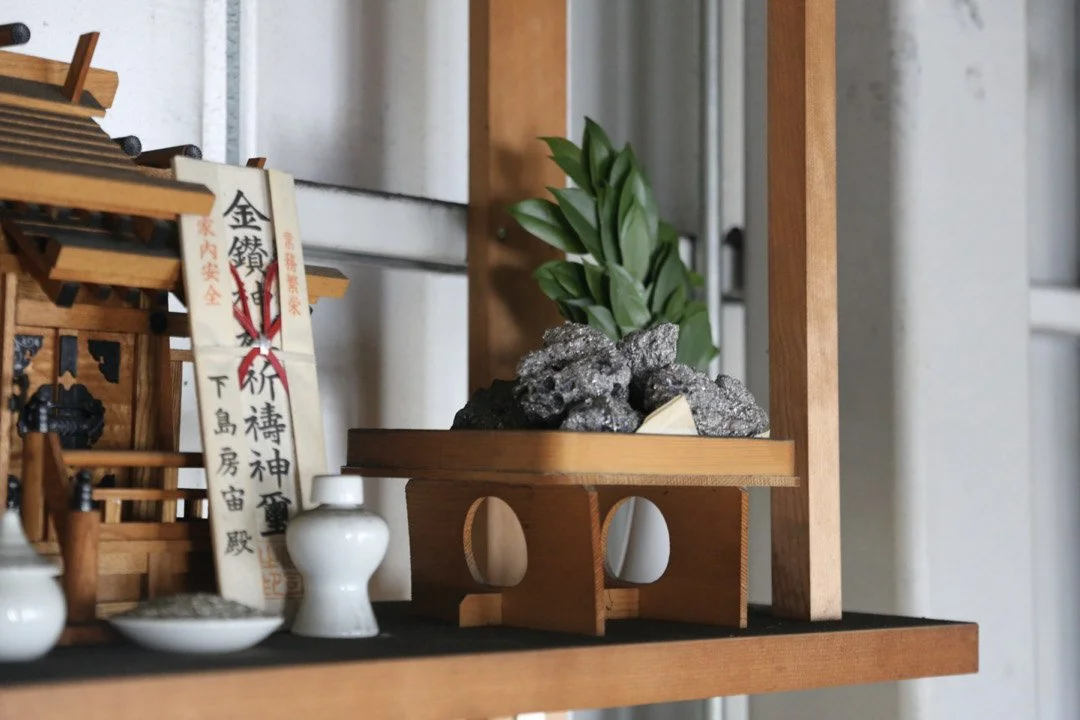
In Shinto practice, meaning emerges from structure. Objects such as the kamidana, shimenawa, or ofuda derive their power from how they are placed, framed, and encountered. A shimenawa rope marks a threshold, designating a space as temporarily charged with sacred presence. Similarly, a household kamidana operates through proportion, elevation, and orientation. This emphasis on relational space, particularly how materials organize attention toward what cannot be seen, has shaped a distinctly Shinto aesthetic language. Rooted in abstraction, natural materials, and reduction, it offers a model of spirituality that resonates deeply with Japan’s modern architecture and design, where absence, restraint, and material honesty become vehicles for meaning.
Architecture for the Unseen
At first glance, a kamidana appears deceptively simple: a small wooden altar or shelf mounted high on a wall, often consisting of a shallow platform, miniature shrine elements, or a restrained frame designed to hold ofuda talismans. Yet within Shinto thought, it functions as a fully articulated spatial device, an architecture scaled to the domestic interior, designed to host divine presence. Unlike religious objects intended for visual contemplation, the kamidana is defined less by what it shows than by how it is positioned. Orientation, elevation, and material restraint shape its meaning, making it less an altar in the Western sense than a framework that organizes attention toward the unseen.
Shinto privileges place-making over iconography. The sacred emerges through the correct configuration of space, and kami are not represented by human figures. The kamidana operates precisely according to this logic. Installed above eye level, typically facing south or east, and never placed beneath a second floor, a doorway, or areas associated with impurity such as kitchens or bathrooms, it establishes a clear vertical and moral hierarchy within the home. These spatial rules mirror those governing shrine precincts, compressing cosmological order into a domestic scale. The act of looking up toward the kamidana becomes a physical gesture of respect, reinforcing the sense that the divine is approached through orientation, not representation.
Material choice reinforces this spatial ideology. Traditionally crafted from untreated hinoki cypress, the same material used in Japan’s most revered shrine, Ise Jingu, the kamidana privileges lightness, grain, and scent over ornament. Hinoki’s pale surface ages slowly, developing a subtle patina without losing clarity, embodying Shinto’s understanding of purity (kiyome) as a condition maintained through care and balance. This preference for renewable materials reflects a broader Shinto worldview in which the sacred is sustained through cyclical renewal. At Ise Jingu, the shrine complex is ritually dismantled and rebuilt every twenty years, underscoring the idea that continuity lies in repetition and transmission.
Equally significant, however, is what the kamidana excludes.
The space beneath and around it is kept deliberately uncluttered, allowing the presence of kami to be suggested. This sensitivity to absence resonates with a broader Japanese spatial tradition, often structured by controlled voids, a logic visible in tea rooms, tokonoma alcoves, Zen temple gardens, and even the pauses built into traditional domestic interiors.

Contemporary designers increasingly approach the kamidana as a spatial prototype, a device for articulating invisible boundaries within the home. Among the most compelling examples is God’s Line, a Shinto altar awarded the 2018 Good Design Award, which distills the kamidana to its most essential architectural gesture.
Rather than reproducing the shrine-like volume that has traditionally defined domestic altars, the design extracts only the outline of the form, rendering it as a light, framed structure that draws a clear line between the sacred realm and human space. In doing so, it resolves a long-standing tension within the kamidana industry: how to maintain reverence for the gods while integrating seamlessly into increasingly Westernized interiors devoid of Japanese-style rooms.
God’s Line attempts to modernize the kamidana through conceptual fidelity. Its emphasis on lightness, both visual and physical, allows it to inhabit contemporary homes without imposing itself, even attaching to delicate plasterboard walls, while preserving the dignity expected of a sacred object. Designer Keita Hanzawa has noted that this restraint aligns with a fundamental Shinto understanding of divinity, according to which the kami manifest themselves through acts of worship. In everyday life, the altar may recede almost entirely into the background. It becomes meaningful only when activated, when hands are brought together in prayer, offerings are placed, and attention is momentarily focused upward. In this way, the kamidana exemplifies an architecture of belief that exists as a structure waiting to be inhabited by intention.
Abstraction as Sacred Language
If the kamidana provides an architecture for the unseen, the ritual objects it shelters articulate a visual language of belief that is deliberately abstract. Ofuda, gohei, and shimenawa signal presence through form, material, rhythm, and placement. In Shinto, meaning is structured, so these objects function as devices that calibrate space, attention, and orientation toward the invisible.
At the center of the kamidana stands the ofuda, a talisman issued by a shrine and believed to embody the divided spirit (bunrei) of a kami. Typically printed or handwritten on paper or thin wood, the ofuda is visually austere: vertical calligraphy, shrine name, and deity designation. However, its power resides in inscription. The calligraphic surface of the ofuda situates it at the intersection of ritual and graphic design. Japanese calligraphy has long functioned as a bridge between spiritual authority and aesthetic expression, where legibility coexists with abstraction. Historically, calligraphy functioned as a carrier of spiritual legitimacy: imperial edicts, religious texts, and shrine documents all relied on the authority of the written line. Within this lineage, the ofuda operates as a sacred text that is meant to be installed. Its verticality echoes the axis of the kamidana itself, reinforcing an upward orientation and situating belief within spatial alignment.
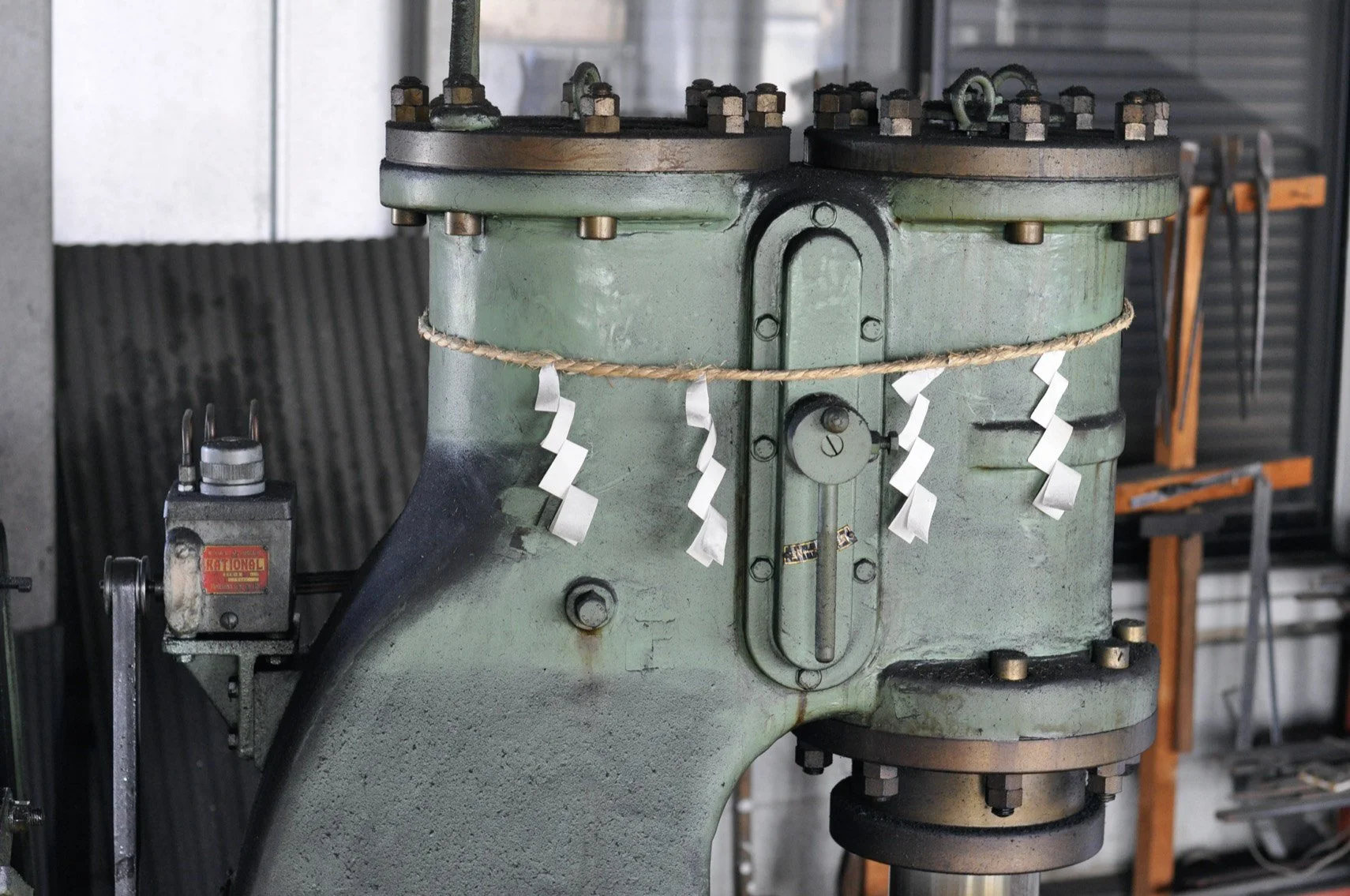
Flanking or accompanying the ofuda are often gohei: ritual implements composed of zigzagging paper streamers (shide) attached to a wooden wand. Their sharply folded geometry has no figurative reference. Instead, it visualizes purification through rhythm and repetition. Shide symbolize the movement of energy and the act of demarcation, marking a space or object as ritually charged.
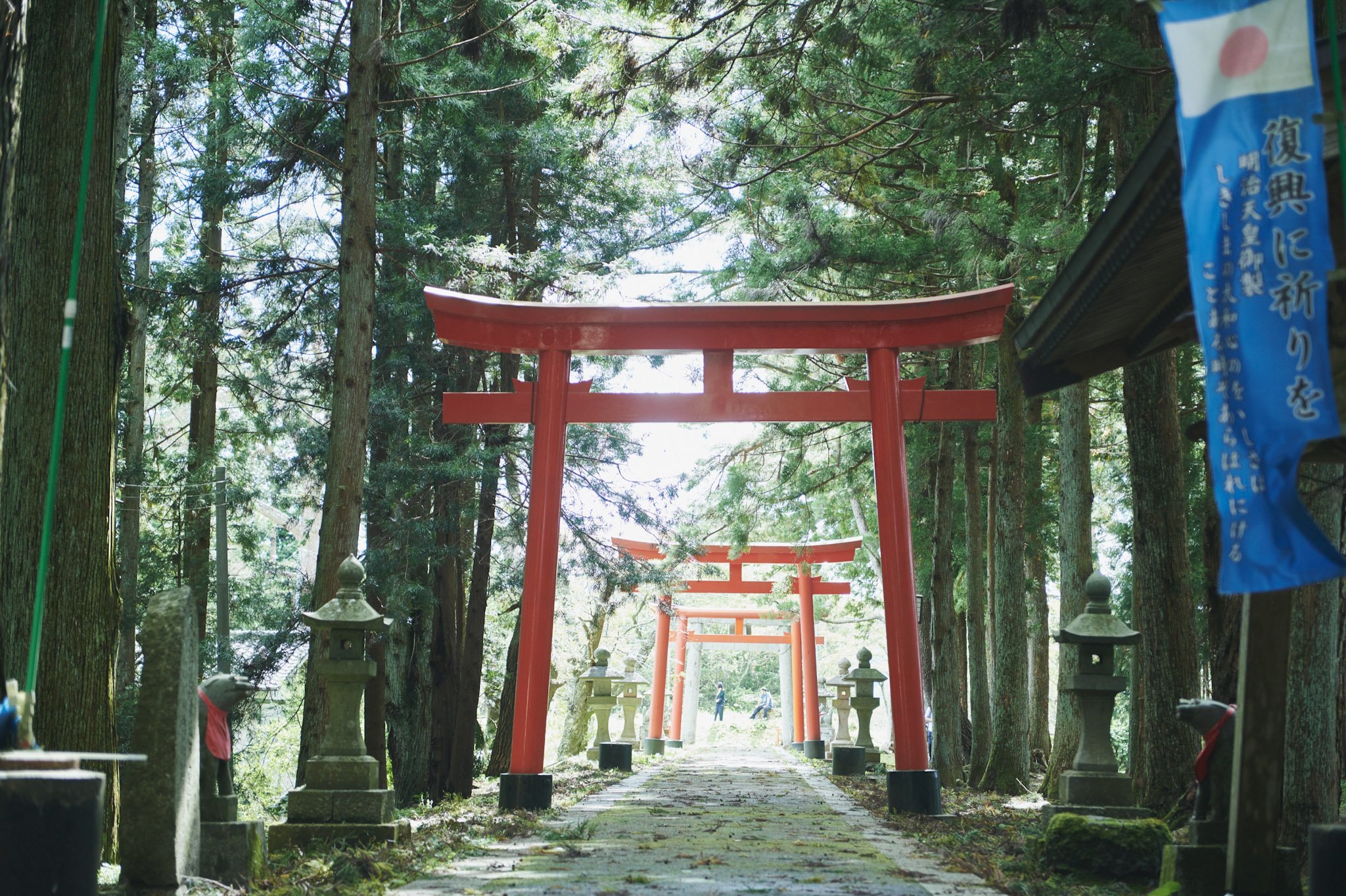
The shimenawa, perhaps the most widely recognized Shinto form, extends this abstract language into architectural and environmental space. Twisted from rice straw and often adorned with shide, it encircles trees, rocks, shrines, and domestic altars alike, designating boundaries where kami are believed to dwell. Importantly, the shimenawa delineates, creating zones of heightened awareness. Visually, the shimenawa is striking in its material honesty. Individual straw fibers remain exposed, knots are visible, and asymmetry is embraced.
This visual vocabulary continues to resonate within contemporary architecture and design. Architect Kengo Kuma has repeatedly cited shrine elements such as shimenawa, torii, and ritual boundaries as formative influences on his approach to space. In projects ranging from the Nezu Museum to smaller timber pavilions, Kuma employs layered thresholds, permeable screens, and natural materials to create environments that feel defined yet open, spaces that guide movement and attention without enclosure. Similarly, contemporary artists working in site-specific installations, such as those exhibited at the Echigo-Tsumari Art Field, frequently use rope, wood, and minimal intervention to mark presence within landscapes, echoing the conceptual logic of shimenawa without reproducing it literally.
Through calligraphic restraint, folded paper, twisted fiber, and carefully placed lines, the sacred is rendered legible to the body moving through space. In this sense, Shinto ritual objects form a grammar of belief, one that continues to inform Japan’s visual culture precisely because it resists fixed imagery, allowing meaning to remain mobile, situational, and alive.
From Ritual to Modernism
Over the course of the twentieth century, a distinctly Japanese language of abstraction rooted in spatial demarcation, material restraint, and non-figurative form, came to permeate architecture, fine art, and design. As Japan’s architects and artists engaged with Western modernism in the postwar period, many looked simultaneously to indigenous visual systems already embedded in Shinto ritual practices.
Japanese architecture possesses an inherent “invisible structure,” evident in shrine architecture as demonstrated by the torii gate, which frames the transition without enclosing the space, and the shimenawa gate, which marks territory without erecting walls. These elements organize perception and movement, allowing the space itself to become expressive. This sensibility finds a powerful echo in postwar modernist architecture, most notably in the work of Kenzo Tange. His early projects reveal a sustained engagement with Shinto concepts of renewal, impermanence, and structural clarity—ideas crystallized through his encounter with the aforementioned Ise Grand Shrine, rebuilt every twenty years, and an embodiment of a cyclical regeneration in which architecture is the process rather than product.
In 1953, Tange and architectural critic Noboru Kawazoe were granted rare access to the reconstruction of Ise, then entering its 59th iteration, a tradition dating back to 690 under Emperor Tenmu. At a time when shrine reconstruction had typically remained closed to public observation, this opening to architects and journalists coincided with the end of the American Occupation and came to symbolize a moment of cultural and architectural reorientation. When Tange and Kawazoe later published Ise: Prototype of Japanese Architecture in 1965, they framed the shrine as a radical model of modernity: an architecture of material honesty, functional clarity, and prefabricated logic.
The same convergence of belief, material presence, and abstraction unfolds in contemporary art, most clearly through the emergence of Mono-ha in the late 1960s. Artists such as Lee Ufan, Sekine Nobuo, and Suga Kishio rejected representation in favor of unaltered materials (stone, wood, earth, steel) arranged in direct relation to space. Their works resisted expressive authorship, emphasizing instead encounters between objects, environments, and viewers. Mono-ha’s refusal to dominate materials mirrors a spiritual ethic in which human intervention is restrained, allowing matter to retain autonomy. In this sense, Mono-ha can be read as a secular extension of ritual abstraction, an aesthetic of belief translated into contemporary art.

Ritual forms endure precisely because their abstraction allows reinterpretation. A shimenawa can inspire a site-specific installation; a kamidana can inform modular architecture; the calligraphic restraint of an ofuda can resonate in graphic design. In each instance, belief translates into form without prescribing meaning.
Seen through this lens, Shinto’s visual legacy becomes a framework through which Japanese creators negotiate modernity itself—offering a language of reduction, relational space, and material presence that continues to shape how Japan designs, builds, and imagines the world.
In regions such as Yoshino, Nara Prefecture, renowned for its hinoki cypress and shrine carpentry traditions, techniques once reserved for kamidana and sacred fittings continue to inform contemporary furniture and architectural production, extending ritual joinery into modern contexts. Belief is then transmitted through practice, in the measured proportions, repeated gestures, careful selection of materials, and sacredness emerges as a discipline of attention embedded in making itself.
Shinto-derived forms endure because they are abstract enough to migrate across disciplines, light enough to integrate into modern life, and structured enough to retain symbolic gravity. The aesthetics of belief is less about religion than about orientation: how space is organized, how materials are respected, and how meaning is allowed to surface through absence. In workshops, studios, homes, and landscapes, Shinto belief continues to be installed quietly, through design choices that make room for the unseen.
About the Author: Sébastien is a writer and videographer living in Tokyo. Born in 1995 under the sun of Marseille in the South of France, he has been living in Japan since 2022. He has written for several international media outlets, mainly about Japan, art, and cinema. In his free time, he enjoys drinking coffee and taking 35mm photos.

Recommended Reads



Get right next to the action and observe an authentic sumo training session