
Introduced to Japan via Portuguese traders in 1549, Christianity remained an underground movement for more than 200 years before re-emerging in Nagasaki, leaving a profound impact on Japanese history despite its relatively small number of followers.
Among the more surprising artifacts exhibited in Japanese museums are small metallic plates depicting the Virgin Mary and the Crucifixion of Christ. Originally used as devotional items by covert Christian followers, the plates took on a different role in the 17th century, transformed into instruments of religious persecution—especially in the port city of Nagasaki. Citizens from all walks of life—commoners, monks, samurai—were obligated to trample the plates as a test of their faith; those who hesitated—or in some cases, refused—were arrested. On some of these fumi-e, or “stepping-on pictures,” the faces of Jesus and Mary became smoothed from the countless steps.
Bronze examples survive today in the Tokyo National Museum, among other sites of preservation, where the smoothed faces of Christ and Mary remain visible reminders of their historic use. Yet, not just situated in the past, these plaques have also served as the source of inspiration for both book and film alike, including the 2016 Martin Scorsese film adaptation of Endo Shusaku’s Silence. Both book and movie follow the two priests from Portugal seeking their missing teacher—an imaginary plot, inspired by unflinching reality.
Christianity arrived in Japan in 1549 and spread rapidly before facing more than two centuries of persecution and underground practice. Despite its suppression, it left lasting traces in Japanese culture, from art and education to language and medicine. The fumi-e speak to a history larger than religion itself, raising enduring questions about conscience, political loyalty, and the price of remaining true to one's beliefs.
Strangers from the South
Business was what first brought the Portuguese.
They arrived by ship in the early 1540s, when warlords in Japan were battling mercilessly to gain control over the nation. These warlords, desperate for victory, were interested in whatever could give them an advantage over their foes—in particular, guns. For some years the Portuguese were valued suppliers, not teachers or threats; the arrival of priests in 1549 added a new question: not what the foreigners sold, but what they believed.
.On August 15, 1549, five years after the initial landing of the Portuguese ships, a Jesuit, Francisco Xavier, came ashore in Kagoshima. Xavier’s journey was no accident; instead, he was drawn there by the stories of Anjiro, a samurai he met in Malacca who had fled Satsuma after committing murder, and who would later be baptized in Goa and serve as Xavier’s personal interpreter.
Yet translation problems arose right away.
At Anjiro’s proposal, Xavier approved the name for God as Dainichi—the name of the cosmic Buddha Dainichi Nyorai, the central Buddha of the Shingon sect, whose body is said to be the entire universe and of whom the historical Buddha, Shakyamuni, is regarded as an emanation. To Japanese ears, an all-encompassing source of the cosmos seemed a fair match for the Christian God. When Xavier arrived in Yamaguchi in 1551 and witnessed the enthusiastic reception of the Shingon monks, his error was evident: rather than understanding Christianity as a distinct religion, it had been regarded as a new Buddhist sect—a warm reception built on a misunderstanding. Seeing this, Xavier switched promptly to the Latin name, Deus.
A separate name for a separate god.
The growth of the Christian mission went hand-in-hand with its increasing value to Japanese rulers: missionaries moved in merchant ships, and so welcoming ports attracted Portuguese traders. These caravels began their journey in Goa before crossing Macau, and served as an intermediary between China and Japan—bringing Chinese silk eastward and Japanese silver westward.
The first Christian daimyo lord was Omura Sumitada. Baptized in 1563, he opened Nagasaki Harbor to Portuguese merchants in 1570. Just 10 years later, in 1580, fearing a rival faction might seize control of the port, he ceded Nagasaki and the surrounding Mogi to the Jesuits. They governed the city for seven years, during which more than ten churches were built. Kindness was part of the mission too: in 1556 the Portuguese merchant Luis de Almeida, by then a Jesuit, paid for a hospital in Funai (present-day Oita) that brought Western surgery to Japan, and he also founded an orphanage.
Yet the missionary message was not always peaceful: after Omura’s conversation, he ordered Buddhist temples and Shinto shrines razed, and his subjects were made to convert or leave his domain.
The mission also expanded by training and educating Japanese converts. The Jesuits established schools and seminaries, cultivating a generation of local believers who could help carry the faith forward. In 1582, Jesuit visitor Alessandro Valignano took this ambition a step further, sending four Japanese Christian teenagers to Europe on what became known as the Tensho Embassy. Their journey had several aims: to introduce Japan to European audiences, give the young envoys firsthand experience of the Church’s wealth and influence, and secure greater support for the Jesuit mission.
Sailing from Nagasaki via Macau and Goa, the boys eventually reached Lisbon, where they were welcomed by Philip II of Spain, before being received by Pope Gregory XIII. They returned to Japan in 1590, eight and a half years after their departure, bringing with them a European printing press. With schools, seminaries, and the means to print its own texts, the Japanese church had begun to establish the foundations for a lasting presence. By the beginning of the seventeenth century, an estimated 300,000 or more.
Stepping on Faith
It was a brief display of hospitality.
In 1587, as Toyotomi Hideyoshi sought to consolidate power in Japan, he ordered the expulsion of Christian missionaries and took direct control of Nagasaki. Concerned by the transformation of the port into a Jesuit stronghold, as well as rumors that Christian conversion could pave the way for European domination, Hideyoshi adopted an increasingly restrictive stance—a view that only solidified in 1596 when a Spanish galleon shipwrecked along the shores of Japan. In February 1597, twenty-six Christians, both foreign missionaries and local laymen, were marched from Kyoto to Nagasaki and crucified on a hill. Despite this persecution, Hideyoshi remained keen to maintain trade relations with foreign powers, and, as a result, enforcement of the ban remained inconsistent, allowing missionary activity to continue.
Initially, Tokugawa Ieyasu tolerated Christianity because of the trade it brought with Portugal and Spain. But a series of incidents, including a 1610 clash at Nagasaki that destroyed a Portuguese ship and a bribery scandal involving Christian officials, began to undermine that arrangement. Ieyasu increasingly came to view the foreign religion as a political risk. However, in 1614, he banned the religion throughout Japan and ordered the expulsion of missionaries, who were sent to Macao and Manila. The next major turning point came in 1637, when peasants in the Shimabara and Amakusa Islands, suffering from oppressive taxation and famine, rose in rebellion—some of whom were also secret Catholics. Led by the young Amakusa Shiro, they seized Hara Castle and held it for several months against an army of more than 100,000 men. The rebellion was eventually crushed, resulting in heavy casualties. Historians continue to debate whether the uprising was motivated primarily by religious or economic grievances, yet the results that followed were clear: the Portuguese were expelled from Japan, the Dutch were confined to trading at a small harbor in Nagasaki, and the country entered a period of sakoku, or national seclusion.
The authorities used two main methods to identify suspected Christians. The first was the terauke system, which required every family to register with a local Buddhist temple to certify that its members were not Christians. Historians believe this practice helped establish the tradition of holding funerary and memorial ceremonies at the family’s registered temple. The second was the fumi-e system, which required people to trample on an image of Christ or the Virgin Mary. Those who refused were tortured and, in some cases, ultimately killed. It is this second method that Endo’s Silence turns into its central test: the young priest at the heart of the story is finally made to decide whether to put his foot on the face of Christ.
Those who managed to escape persecution became known as kakure kurishitan, or hidden Christians. Primarily farmers and fishers, they settled in places such as the Goto Islands, the Sotome coast, and Amakusa, where they continued to worship in caves and private homes. With no ordained priests to lead them, religious traditions were passed down orally, and, over time, their prayers gradually evolved into chants that incorporated elements of Buddhist practice. Hidden Christians also kept statues of Kannon, the bodhisattva of mercy, whose likeness to the Virgin Mary holding the infant Jesus helped conceal their faith during inspections by the authorities. These statues became known as Maria Kannon. Their Christian beliefs and stories were also preserved in an oral text known as Tenchi Hajimari no Koto (The Beginning of Heaven and Earth).
Even amid persecution and transformation, Christianity survived.
The hidden Christian community came to light in 1865, following Japan's gradual reopening to foreign relations. French missionaries had built a small church in Nagasaki, Oura Church, to serve the foreign residents living there. On March 17, a group of people from the neighboring village of Urakami entered the church. One woman approached the priest, Bernard Petitjean, and told him, “Our hearts are like your hearts,” before asking about the statue of Mary. It had been more than 250 years since the hidden Christians had encountered a priest.
The news reached Rome, where Pope Pius IX declared the encounter the “Miracle of the Orient.” In Japan, however, the response was less welcoming, and the authorities continued to suppress Christianity for several more years.
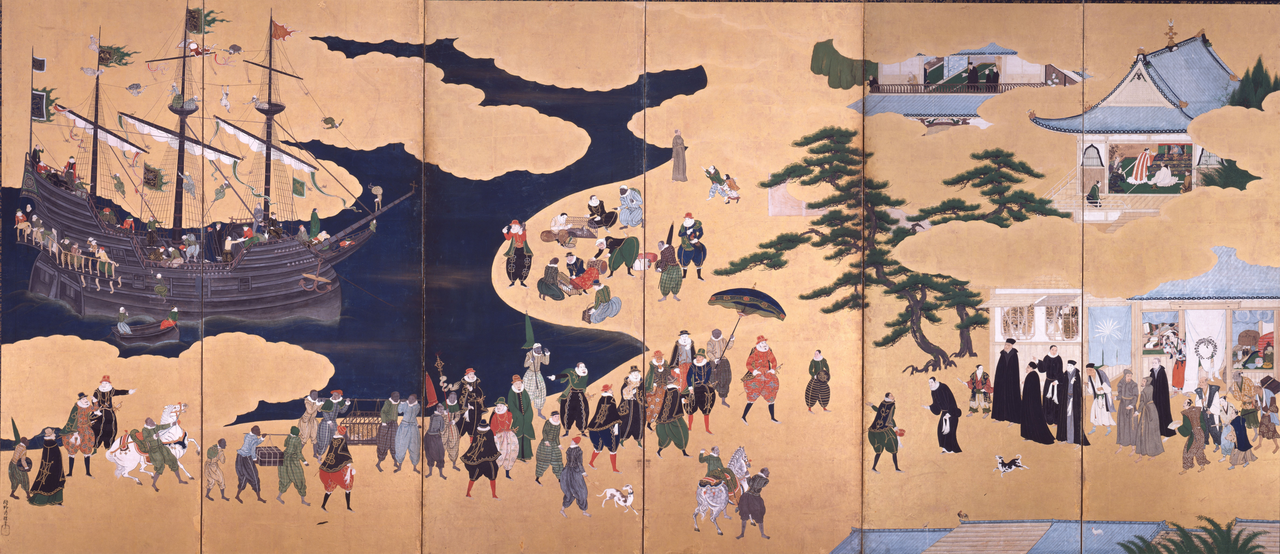
Nanban screens by Kano Naizen, c. 1600, Kobe City Museum
What the Ships Left Behind
The Christian century left a lasting mark on Japan, beginning with the transmission of language. In 1603, the Society of Jesus published the Nippo Jisho in Nagasaki, the first Japanese-Portuguese dictionary, containing around 32,000 entries. Portuguese words became part of everyday Japanese vocabulary, and many remain in use today: pan (bread), tabako (tobacco), botan (button), karuta (playing cards), konpeito (star-shaped sugar candy), and kasutera, a sponge cake whose name derives from Castile; all claim roots in Portuguese. Even tempura is believed to possibly derive from tempero (seasoning) or the Latin tempora, referring to days of fasting during Catholic holidays.
Portuguese influence also extended to medicine and the visual arts. Luís de Almeida, a Portuguese priest who had previously worked as a merchant, helped establish Japan’s first hospital and orphanage in Funai, present-day Oita. He became well known for his role in introducing European medicine to Japan. Meanwhile, the subjects depicted in Japanese art began to broaden. Kano Naizen’s Nanban screens, dating to around 1600 and rendered in gold leaf, depict a black Portuguese ship unloading goods, a lavishly dressed captain, and Jesuit priests in black. The term Nanban, meaning “southern barbarians,” was used to refer to Europeans arriving in Japan from the south.
When the ban was lifted, missionaries returned to Japan, including Protestant groups. Many, however, shifted their focus toward establishing schools and hospitals. Christian educational institutions continue to attract students despite Christians accounting for only around one to one and a half percent of Japan’s population—Tokyo’s Sophia University, run by the Jesuit Order, is one such example. Christian influence also extends to modern wedding customs. For decades, increasing numbers of Japanese couples have chosen to hold Western-style Christian weddings, complete with a chapel, white dress, and hymns.
The history of Christianity in Japan is perhaps most deeply felt in Nagasaki.
In the area where hidden Christians had lived for two and a half centuries, a red-brick cathedral was built and opened in 1925. It became the largest cathedral in East Asia. On August 9, 1945, an atomic bomb detonated above the city, with the cathedral standing only about 500 meters from the hypocenter. According to the Nagasaki Atomic Bomb Museum, more than 10,000 of the approximately 15,000 Christians living in the city at the time were killed. The cathedral was later rebuilt, and its bell still rings today. Later, in 2018, UNESCO recognized twelve sites associated with the Hidden Christians in the region as World Heritage sites, including Oura Church, the oldest Christian church in Japan.
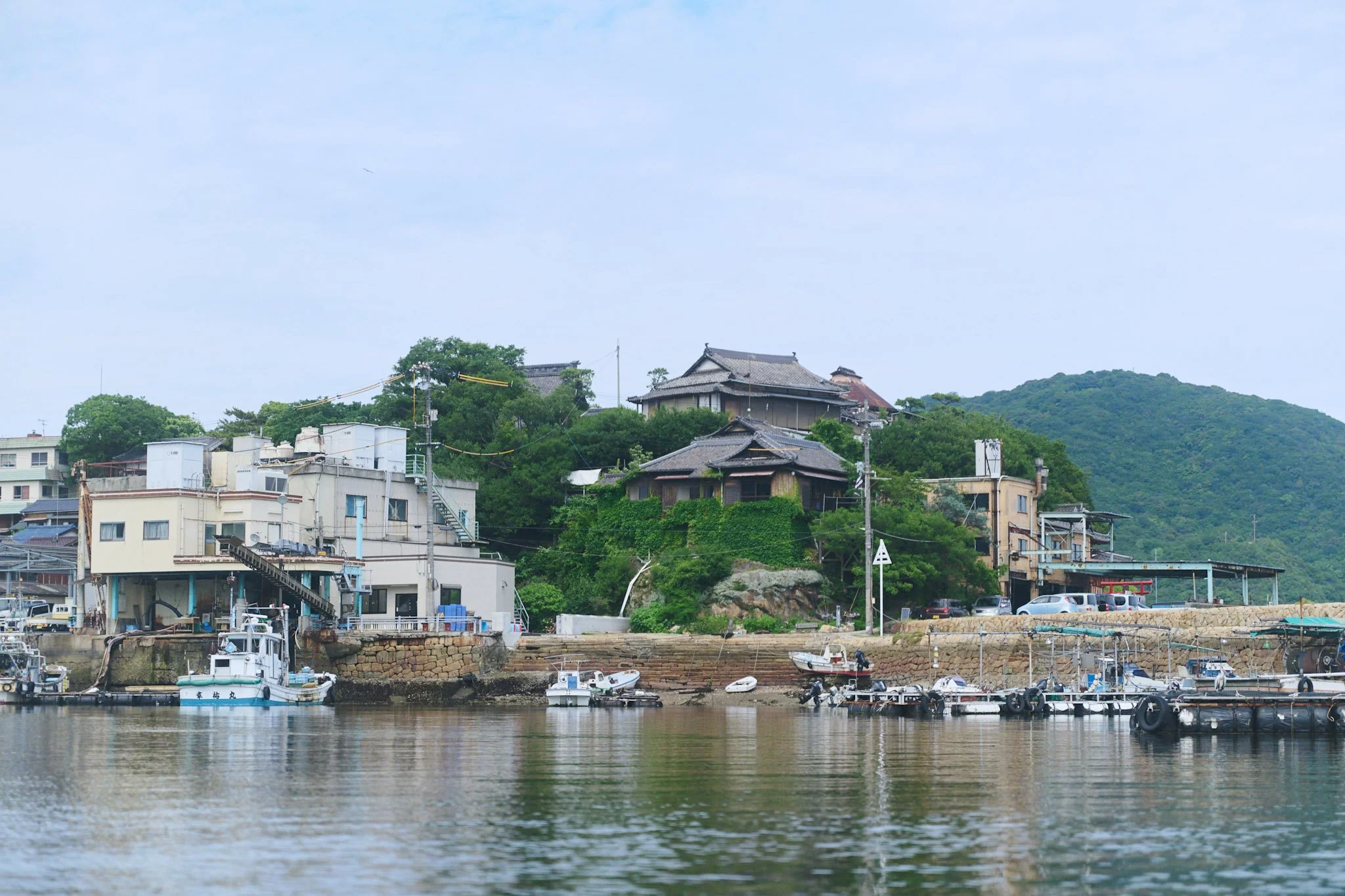
In the Tokyo National Museum, the bronze plaques continue to rest in their glass cases, the faces of Mary and Christ rubbed smooth by thousands of feet. But the cases cannot convey what happened after the inspections were complete: the officials moved on to the next house, and the family resumed its place inside. For more than two hundred years, on islands and in fishing villages, people continued to pray using phrases whose meanings had gradually faded, addressing a God they could not name aloud. Christianity did not transform Japan, nor was it given the opportunity to do so.
Instead, it left its mark on the country in quieter ways: in the words on Japanese tongues, in the schools and hospitals that carry its name, and in the questions of faith and conscience that Endo and Scorsese could still make audiences feel four centuries later. Many of those who were made to step went home and kept believing—quietly, stubbornly, for generation after generation until the day they could say so aloud.
About the Author: Chan Lap In (Lester) is a writer from Macao with a lifelong interest in history, culture, and geography. He is drawn to the places where Chinese, Portuguese, and Japanese histories overlap.
Revised by Taylor Bond

Recommended Reads

Discover Cultural Experiences


Get right next to the action and observe an authentic sumo training session