
Bygone Beauty: Cosmetic Practices of Edo Japan
Ancient Edo beauty techniques, the unexpected counterpart to modern cosmetic practices, and what these aesthetics said about their time.
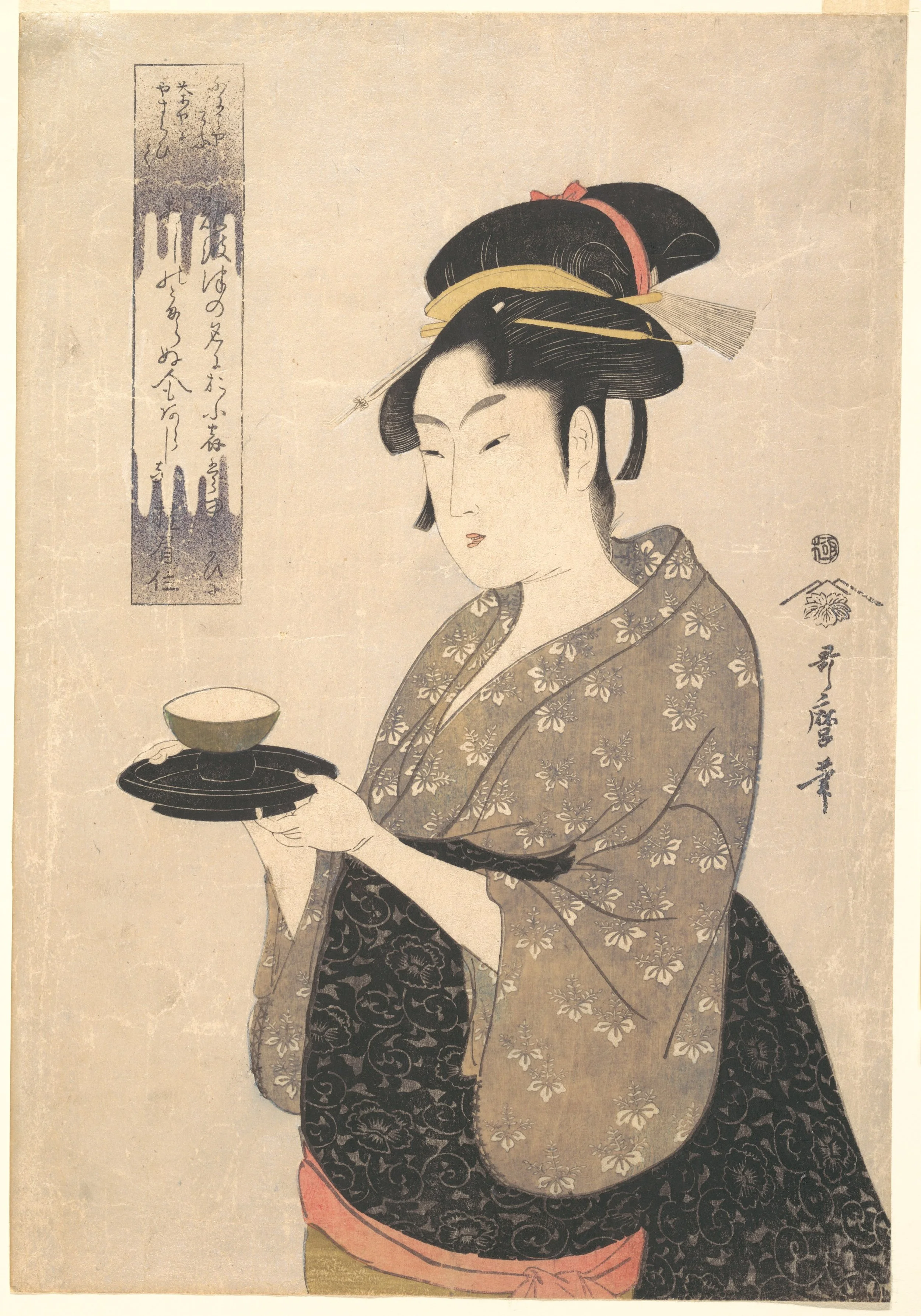
Kitagawa Utamaro, Naniwaya Okita (c. 1793)
You’ve probably seen her before: a pale-faced Japanese woman gazing quietly from an ukiyo-e woodblock print. Her name is Naniwaya Okita, a tea-house waitress of the late eighteenth century who became one of many townswomen drawn by the ukiyo-e master Kitagawa Utamaro. His bijinga ("pictures of beautiful women") would eventually cross oceans during the age of Japonisme, helping to shape the world's enduring image of traditional Japanese beauty.
While these prints are widely recognized as idealized images of “traditionally” beautiful women, they are rarely considered as portraits of individuals who embodied the beauty culture of their own time. What we now call dento kesho ("traditional Japanese makeup") largely took shape during the Edo period. While cosmetics had existed in Japan for centuries, they had previously been associated primarily with court ceremony, religious ritual, and the warrior elite. As Edo (present-day Tokyo) grew into one of the world's largest cities and an increasingly prosperous merchant class embraced an expanding consumer culture, beauty became part of everyday urban life. Fashion manuals, cosmetic advertisements, and ukiyo-e prints spread the latest trends, while cosmetics themselves became increasingly accessible. By the late Edo period, a distinctive aesthetic had emerged, centered on three defining colors: the luminous white of oshiroi foundation, the vivid red of beni rouge, and the deep black of painted eyebrows and ohaguro tooth-blackening.
Yet behind the attention-grabbing aesthetics of the bijinga lies an often-overlooked question: how did women, like Okita, actually achieve this iconic look each morning?
From cleansing the face and applying cosmetics to arranging the hair and dressing in a kimono, each stage of an Edo-period makeup routine reveals the cultural conventions that shaped and expressed ideals of feminine beauty in premodern Japan–and while centuries away from contemporary standards, still retain traces that mirror our own modern aesthetic regimens.
Prepping the Base of Edo Era Beauty
For an Edo bijin like Okita, the beauty routine begins long before opening her makeup box. Rising with the sun, the first step starts with brushing the teeth with a fusayoji, a toothbrush made from a willow twig–its frayed end dipped into a fragrant tooth powder scented with ingredients such as clove and borneol. Only then would the most important part of the morning ritual begin: caring for the skin.
Like today's "no-makeup makeup," the fashionable look among Edo townswomen was one of usugesho, or “light makeup.” Thus, washing the face went beyond a matter of cleanliness. If a curious shopper had picked up one of Edo's bestselling beauty guides, Miyako Fuzoku Keshoden (“Cosmetic Traditions of the Capital”), she would have found advice to cleanse the face gently with a rice-bran pouch (nukabukuro), warning that vigorous scrubbing would damage the skin's delicate grain. Lukewarm water, the guide adds, is kinder to the complexion than water that is too hot.
For those truly meticulous in their pursuit of beauty, the skincare routine would have ended with a light application of Edo no Mizu, a cosmetic lotion used beneath oshiroi foundation. Marketed by the playwright and pharmacist Shikitei Sanba as "the lotion that keeps your oshiroi from peeling," it became one of Edo's most successful beauty products through clever advertising in illustrated books and woodblock prints.

Priming in White: Traditional Oshiroi Foundation
With the base of the traditional Japanese beauty routine securely set, next would come the signature step: white foundation. Seated in front of a mirror, women like Okita would moisten a small sponge, dip it lightly into a dish of oshiroi, and begin patting the white foundation thinly across her face. The popular look among Edo townswomen was not one of heavy makeup, but of flawless, even skin. Foundation would stretch across her neck to the nape just above the kimono collar, leaving a glimpse of bare skin that Edo fashion considered especially graceful. Bit by bit, the careful skincare base constructed in the morning would disappear beneath a smooth, luminous complexion.
Which brand of oshiroi these women chose to wear often depended on advertisement, specifically, on who advertised it. Take, for instance, the highly popularized oshiroi sold by the celebrated kabuki actor Kamimura Kichiya (active 1673-1681), one of the first performers to turn theatrical fame into a cosmetics business. After retiring from the stage, the famed onnagata opened a shop in Kyoto selling Kichiya Oshiroi, allowing admirers to purchase the very foundation associated with their favourite star–showing the origins of celebrity beauty brands as far older than imagined.
Like many cosmetics of the period, however, oshiroi concealed an unexpected secret. The white powder was traditionally produced by heating mercury with salt, clay, and water. Although the process produced the radiant finish that women admired, it’s now known that prolonged mercury exposure has harmful impacts on health–a danger no impediment for the beauties of Edo in pursuit of vogue.
Once foundation was set and the canvas blank, the fashionable woman of Edo then turned to the next step: bringing the look to life with color.
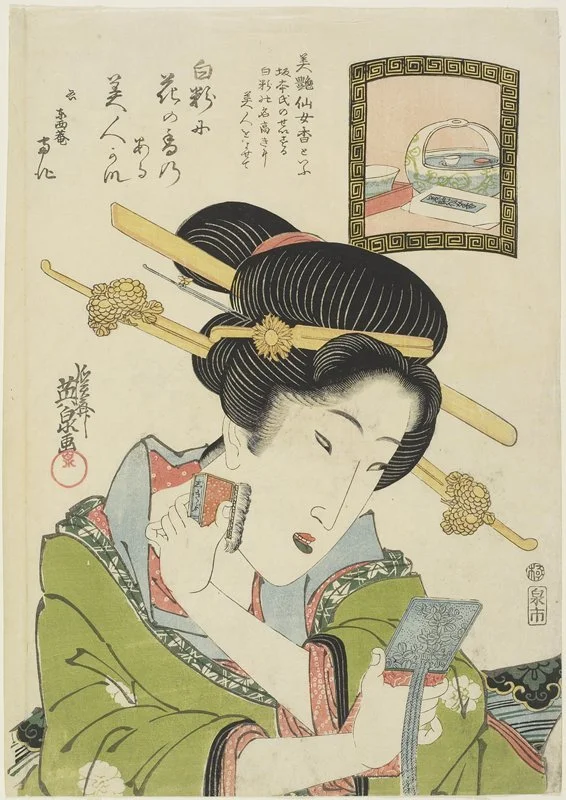
Keisai Eisen, Woman Putting on Face Powder, (c. 1824)
The Beauty of Black in Edo Makeup
Black was the second of Edo beauty's defining colors.
Definition began with eyebrow ink. Unlike today, fashionable eyebrows were not simply shaped but often redrawn altogether. Women plucked away much of their natural brows before painting new ones with mayuzumi, allowing their shape to reflect the latest fashions. Eyebrows were more than decoration; whether they were natural or drawn on quietly communicated a woman's age, social status, and stage of life. For instance, young girls generally kept their natural brows, whereas married women increasingly shaved them. Also, while townswomen typically kept the shaved area bare, elite women replaced them with painted brows high on the forehead, a tradition carried on from aristocratic courts of the Heian period (794-1185). Indeed, as early as The Tale of Genji, a young Murasaki is described as wearing “natural, childlike eyebrows.” Only after she comes of age does she receive eyebrow makeup.
Similarly, the ohaguro, or "tooth blackening", was practiced by women who reached adulthood, acknowledged as a marker of a refined young woman. Both blackened teeth and carefully painted brows signalled proper etiquette for adult women, and to appear without them at important occasions could be considered as improper as appearing in public today without finishing one's grooming.
Although aesthetically peculiar to modern eyes, ohaguro was admired for the elegant contrast it created against the brilliant white of oshiroi. The dark lacquer-like finish also helped preserve the teeth, making the practice both cosmetic and practical. Together with eyebrow ink, the black accents framed a woman’s face with quiet precision.
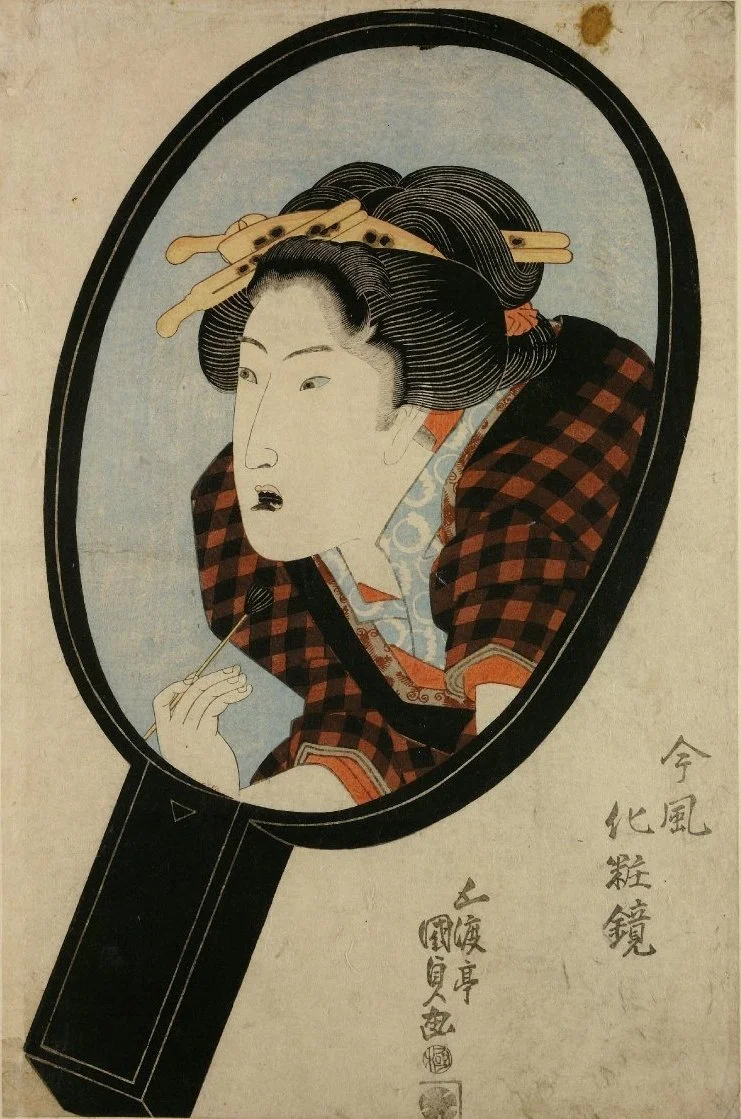
Utagawa Kunisada I, Tooth Blackening, from the series Mirrors of the Modern Boudoir (c. 1823).
Seeing Red: Framing Edo Faces
Inside the smallest and most precious container in a townswoman’s makeup box was beni, the vivid safflower rouge that gave life to her otherwise porcelain complexion. After dipping the tip of a small brush into the pigment and gently touching it to her lower lip, the color bloomed slowly across her face. Unlike modern lipstick, beni was applied in translucent layers, allowing each woman to decide how subtle or striking she wished to appear.
Beni was among the most expensive cosmetics of the period, giving rise to the saying, "One monme of beni, one monme of gold." One sloppy application could cost a townswoman nearly her days’ worth of earnings.
Occasionally, however, women applied the beni generously to create the shimmering effect known as sasairo beni ("bamboo-leaf rouge"). By applying many layers, the crimson pigment would catch the light with an iridescent green sheen. It was an extravagant trend, admired as much for the wealth it implied as for its unusual beauty. Not every townswoman could afford such luxury. For regular townswomen like Okita, the Miyako Fuzoku Keshoden guidebook offered a thrifty alternative: one should darken the lips first with soot from an oil lamp before applying a small amount of beni, creating a similar greenish lustre while using far less of the precious pigment.
Though near-finished, the look still called for one final flourish. Inspired by the stage makeup of kabuki actors, women often placed the faintest touch of beni at the outer corners of her eyes, a style known as mehajiki. A subtle detail, yet it implicitly conveys to those who notice that the wearer actively kept up with the latest fashions.
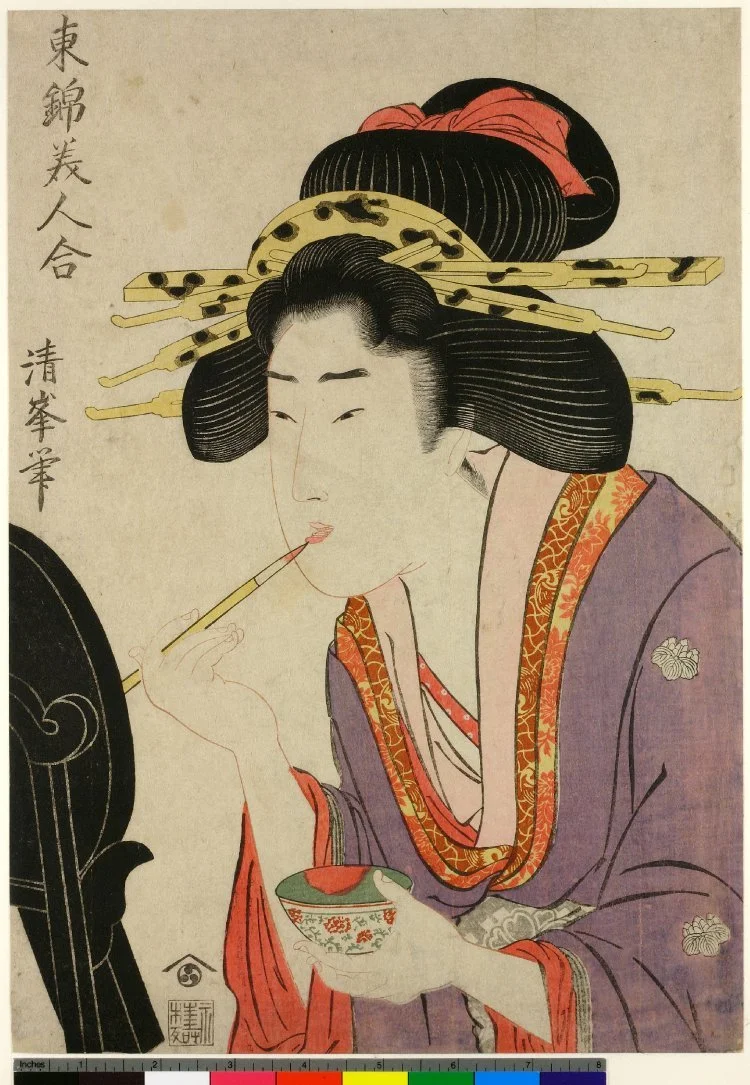
Torii Kiyomine, Lip Rouge, from series Azuma Nishiki Bijin Awase, (c. 1810–1813)
Dressing with Iki: An Edo Era Aesthetic
With makeup complete, it was on to the final step in the Edo beauty routine: hair. A carefully waxed shimada mage, laid carefully to rest for the night on a wooden headrest (takamakura), needed only a few deft adjustments before wear–only a stray lock might have been smoothed into place with a touch of hair wax, before straightening the boxwood comb and decorative hairpin nestled within the topknot.
Edo hairstyles were built from four main elements: the topknot, the side locks, the forelocks, and the hair at the nape. By rearranging these, hairdressers created hundreds of distinctive styles. Young unmarried women like Okita commonly wore variations of the shimada mage, while subtle differences in shape could signal age, occupation, and fashion.
Combs have been used in Japan since prehistoric times and were once believed to possess protective spiritual powers. By the Edo period, they had become exquisite works of craftsmanship, carved from boxwood or fashioned from tortoiseshell, ivory, lacquer, and metal–a seamless union of beauty and function. For an Edo townswoman, a comb was both an everyday necessity and an expression of her taste.
Once hair and makeup are complete, the townswoman would slip into her kimono, taking up a hand mirror to check the white oshiroi at the nape of her neck before drawing the collar back just enough to reveal it–a style known as nukiemon. Originally adopted to keep hair oil from staining the collar, nukiemon soon became one of Edo's defining expressions of elegance. In contrast to fashionable women in eighteenth-century Europe who celebrated the décolletage, Edo beauty prized suggestion over display. A glimpse of the white-painted nape was considered far more alluring than revealing the chest or shoulders.
This understated refinement was known as iki, the distinctive aesthetic philosophy cultivated by Edo's townspeople. Living under repeated sumptuary laws that discouraged conspicuous luxury, they learned to express sophistication through restraint rather than extravagance. If brightly colored garments were forbidden, they delighted in subtle shades and hidden linings. Iki flourished in the smallest details: a loosened collar, a perfectly placed comb, or a hairstyle softened ever so slightly from perfect symmetry of rigid samurai codes.
With hair, makeup, and kimono complete, the ensemble is ready for the streets of Edo.

The Lasting History of Edo Period Makeup
After a morning of makeup and preparation, a beauty like Okita would be ready to return to where she flourishes: serving tea, greeting customers, and exchanging cheerful conversation beneath the crowds gathering around Senso-ji Temple in Asakusa.
Among the passersby, however, was someone who paused, captivated by the artful presentation in front of him.
Sketchbook in hand, artist Kitagawa Utamaro studied the young waitress, whose luminous oshiroi, understated beni, polished coiffure, and effortless iki embodied everything fashionable about Edo.
In the years that followed, Utamaro immortalized Okita alongside Takashima Ohisa and Tomimoto Toyohina as the celebrated "Three Beauties of the Kansei Era." Their portraits became some of the most recognizable bijinga of the Edo period.
Ukiyo-e prints served as the visual media of the day, and like today's influencers or magazine cover models, featured teahouse waitresses, shop girls, and geisha artists who inspired fashions that others eagerly copied. Curious admirers even sought them out at their workplaces, hoping to catch a glimpse of the women whose faces they knew from prints.
It’s tempting to see traditional Japanese makeup simply as an artistic style preserved in antiquated woodblock prints. But following these Edo women’s morning routines reveals a richer reality: every layer of makeup, every carefully chosen ornament, and every adjustment of a kimono collar reflected a world shaped by women’s choices, drawing inspiration from bestselling beauty manuals, popular kabuki actors, and the latest ukiyo-e advertisements.
In that sense, Edo beauty culture feels remarkably familiar. Every morning, we too stand before a mirror and decide how we wish to present ourselves to the world. That is perhaps why bijinga portraits of women like Okita continue to captivate us more than two centuries later. She was a young woman who simply got ready for work one morning, never imagining that the routine she shared with countless other townswomen would, one day, come to define the timeless image of “traditional Japanese beauty.”
About the Author: Tamaki Hoshi is a scholar and aspiring novelist with a passion for both Japanese women's history and intellectual history. She is currently researching the effects of modernization on Japanese women and the collective memory of motherhood in prewar and wartime Japan at Waseda University. Through her research and writing, she strives to illuminate the untold stories of women in Japanese history.

Recommended Reads

Discover Cultural Experiences


Get right next to the action and observe an authentic sumo training session