
The Chashitsu as the Soul of Japanese Architecture
How Japan’s chashitsu, or tea hut, evolved from Zen simplicity into a timeless architectural form that continues to embody the nation’s spiritual ideals, artistic sensibility, and enduring cultural soul.
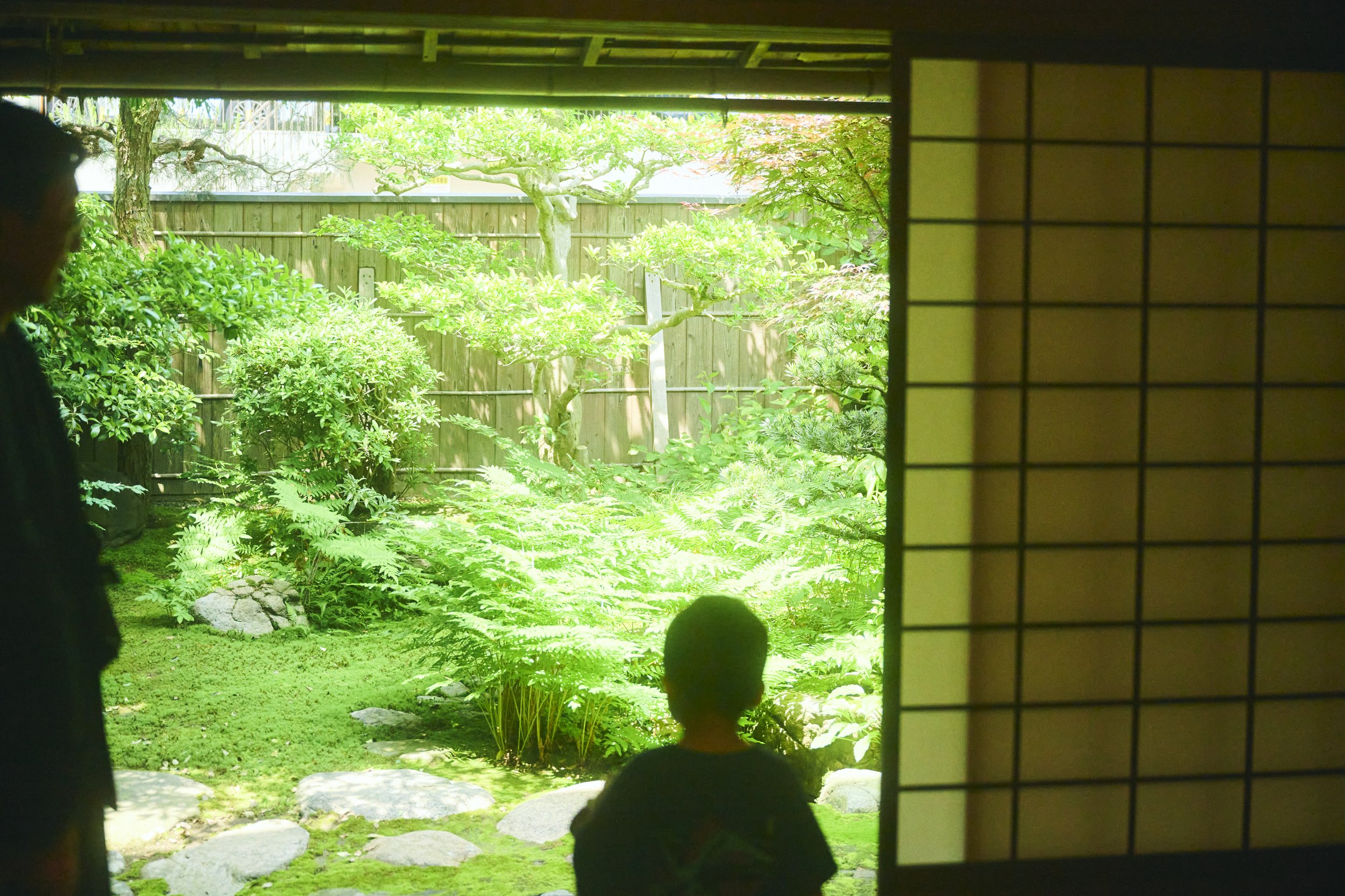
When one imagines Japanese architecture, ornate temples and shrines may come to mind alongside such iconic elements as chochin lantern-lit or noren curtained entryways, or thickly thatched roofs, and bold curvilinear timber frames. Yet for over four centuries, quietly nestled amongst these classic forms and features of Japanese design, sits the chashitsu, or tea hut—a structure uniquely devoted to cha-no-yu, the ceremonial act of preparing, serving, and receiving tea.
In its distilled simplicity, the chashitsu is not merely a setting for tea, but the purest expression of Japan’s architectural spirit. Traditionally rendered as small free-standing wooden structures within gardens, tea houses are approached through a roji path of moss and unhewn stones, once guests are summoned from a machiai portico. At the entrance, a stone basin allows guests to rinse their hands and mouth, symbolizing purification of body and mind. Low eaves, a subdued entry, and quiet surroundings lead to an interior of unfinished wood (often with the bark still attached), tatami of woven soft igusa rush, and shoji paper-filtered light, creating an atmosphere of contemplative calm.
Typically composed of two rooms—a main space for guests and a smaller mizuya (preparation room)—the entire structure often spans no more than three tatami mats in area (roughly 5 sqm). Every surface, threshold, and gesture is calibrated to this scale; the tatami mat itself governs proportion and layout with its modular dimensions (about 1.8 by 0.9 m), reinforcing intimacy and human scale—a principle that continues to influence Japanese design today.
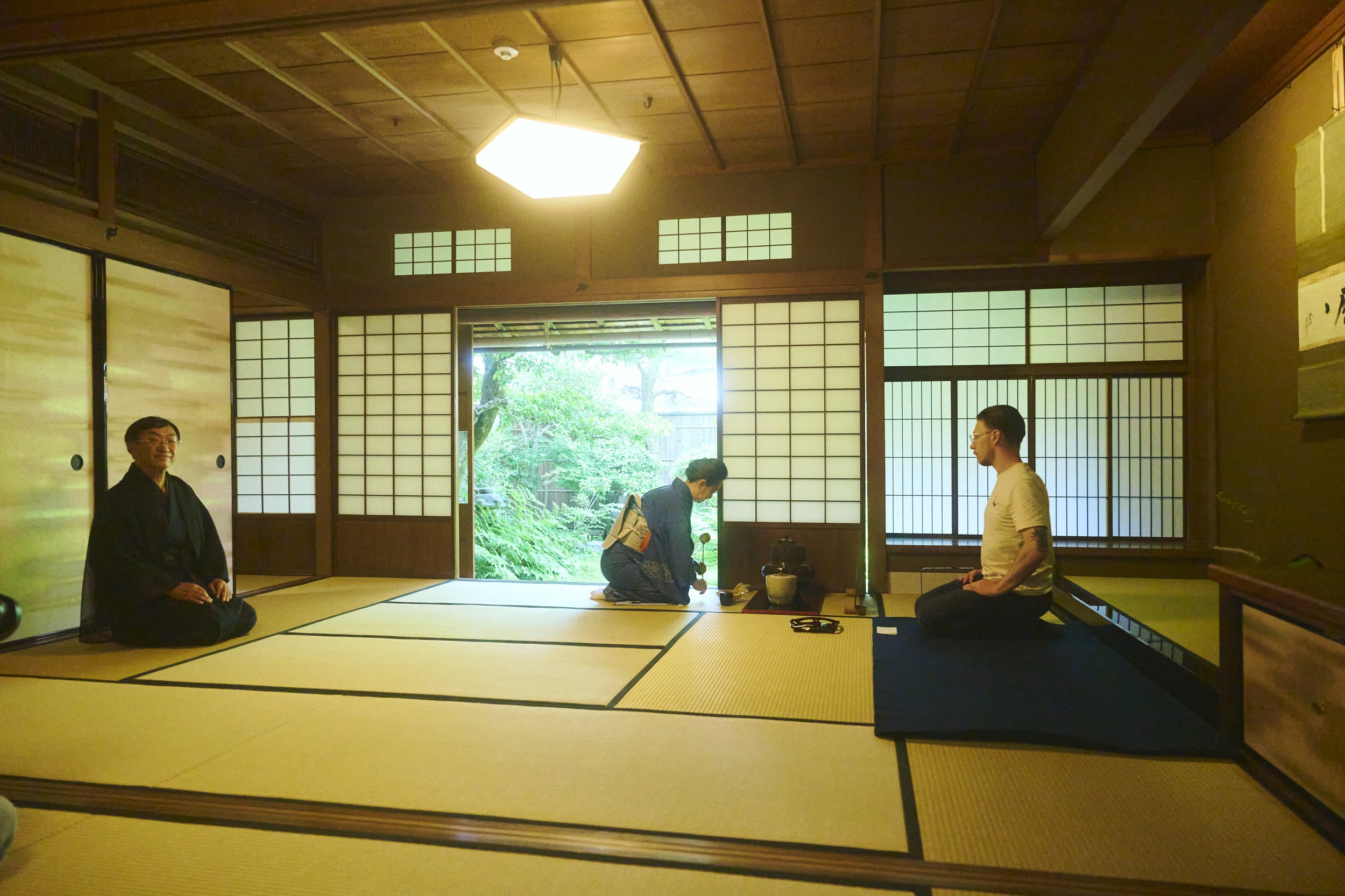
The interior of the tea room is consciously austere. With its low ceilings and absence of furniture, both host and guest sit seiza-style on the tatami, heightening awareness of movement and posture, and focusing attention on the ritual elements of the cha-no-yu. The tokonoma alcove, displaying a single hanging scroll or chabana flower arrangement, serves as the visual focal point, while the small shoji windows admit soft, indirect light that sustains concentration. Subtle shifts in the displays and utensils mark seasonal changes: a sunken hearth (ro) provides warmth in winter, concealed in summer by tatami and replaced with a portable brazier (furo).
Two preparations—koicha (thick tea) and usucha (thin tea)—are served in sequence; matcha, whisked into a froth, induces meditative alertness. Conversation dwells not on flavor but on utensils—bowls, kettles, and bamboo whisks—each chosen for its seasonal or material significance. The raw simplicity of the interior ensures these objects and the host’s choreography of preparing and serving tea—which include thirty-seven steps—remain central. As the “father of the tea ceremony,” Zen scholar and tea master Murata Juko (1423–1502) taught, the spirit of cha-no-yu rests upon four virtues: harmony (wa), respect (kei), purity (sei), and tranquility (jaku). In such a space, architecture and ritual coalesce into one.
In this carefully composed environment, every element—spatial, material, and sensory—serves a single purpose: to quiet the mind and prepare for the ritual of tea. It is precisely this intentional simplicity that gives the chashitsu its distinctive Japanese character.
The Legacy of Monks in the Introduction of Tea as a Ritual
Tea was first brought to Japan from China by scholar-monks as a medicinal and meditative elixir. In 1191, after years of study abroad, Myoan Eisai (1141–1215) reintroduced tea as a complement to Buddhist practice—not as a formal ritual, but as a daily discipline linking its medicinal effects to heart health and longevity. His treatise, Kissa Yojoki (“Drink Tea and Prolong Life”) laid the groundwork for a uniquely Japanese ritual that, over time, gave rise to an architecture of purity and restraint.
Eisai sought to restore the moral integrity of monastic life, then in decline, through writings on proper conduct and discipline. Though his emphasis on tea and meditation drew criticism within the Tenzai Buddhist sect of his origin, his ideas—based in Chan Buddhism, eventually transforming into Zen—gained support under Shogun Minamoto Yoriie and other aristocrats. With the rise of the warrior class during the Kamakura period (1185-1333) and their steadily entangled connection with Buddhism, Zen emerged as one of Japan’s dominant spiritual philosophies, carrying with it the growing culture of tea.
Eisai viewed Zen not only as a path to mental clarity, but as a means of cultivating compassion and protecting the nation. By extending Zen practice to laypeople, he transformed tea from a monastic aid into a moral and spiritual exercise for all. This synthesis of Zen ethics and daily ritual became the foundation of cha-no-yu—with the ceremony as its practice and the architecture of the chashitsu as its vessel. Eisai thus sowed the seeds of Japan’s enduring tea culture.
From an Ascetic to an Aesthetic Awareness
The practice of cha-no-yu was refined through each generation of tea connoisseurs, starting with the aforementioned tea master Juko, and continuing onto Takeno Jo'o (1502–1555), and Jo'o’s disciple Sen-no-Rikyu (1522–1591), who eventually became tea master to powerful samurai lords. In an age before the occupation of architect existed, monks and tea masters themselves designed the tea huts and their gardens. The work of a few central figures introduced an architectural orthodoxy for wabi-style tea culture (wabi-cha): simple structures built with local materials, revealing their construction rather than concealing it. Subdued earth tones, woven mat ceilings, and the absence of ornament replaced the showiness that had once defined imperial tea culture.
Rikyu’s influence on cha-no-yu was transformative. He standardized the procedures, utensils, and design principles that became the foundation for modern schools of the Way of Tea (sado). Rikyu fused the quiet simplicity of wabi with an appreciation for the old and weathered, known as sabi; together, wabi-sabi became central not only to tea culture, but to Japanese aesthetics as a whole.
Architecturally, Rikyu refined the tea room into a small, thatched pavilion called soan, limiting its size, decorative objects, utensils, and other elements to evoke the humbleness of a mountain hut. He also designed the nijiriguchi (“wriggling-in” entrance), compelling all guests to bow as they entered—a symbolic act erasing social distinctions. Within the chashitsu, Rikyu held that all were equal, a revolutionary notion in Japan’s rigid hierarchical society.
Upon retirement, Ashikaga Yoshimasa, a mid-fifteenth century shogun, had refined the four-and-a-half mat tea room, which evolved into a standard expression of austerity for hosting and receiving tea. In the sixteenth century, Rikyu further formalized tea ceremony, refining the soan style to emphasize simplicity, humility, and the use of local materials reminiscent of commoners’ homes—straw, timber, bamboo, paper, and clay. In doing so, he codified what might be called “rustic refined” architecture: unpretentious yet deliberate, modest yet profound, harmonizing craft, material, and spiritual intent. One surviving example, Tai-an, built in Kyoto in 1582, occupies just two tatami mats—one for host and one for guest—and embodies the distilled essence of cha-no-yu.
An Architectural Typology as the Vessel of a Nation’s Soul
Long before Western modernism celebrated simplicity and material honesty, the tea hut had already embodied these ideals. Its human scale and sensitivity to nature allow it to adapt endlessly. Its principles of proportion, intimacy, and natural materiality have enabled the chashitsu to remain remarkably flexible—capable of contemporary reinterpretation while remaining unmistakably Japanese.
Contemporary Japanese architects such as Fujimori Terunobu reinterpret its intimacy through playful forms—a treehouse-like chashitsu or a tea hut suspended in air—preserving wabi-sabi subtleties while embracing imagination. Taking playfulness a step further, Tokujin Yoshioka reimagined the chashitu with Kou-an, a hut made entirely of glass (designed for the 2011 Venice Biennale), featuring light refracted by a crystal prism sculpture that seems to transcend time and space. Yet even this ethereal structure, created for the act of serving and receiving tea in the spirit of Eisai and tradition of Rikyu, remains uniquely Japanese.
Across Asia, spaces for informal tea rituals abound—from China’s gongfucha teahouses to Korea’s meditative darye—yet nowhere else has tea produced a dedicated architectural typology. Though it generally takes a decade to master the ceremony in its proper form, cha-no-yu has been preserved for over five centuries through the iemoto (head houses) of chado lineages claiming descent from Rikyu, Omotesenke and Urasenke, ensuring the chashitsu endures as a key cultural venue of Japan. Even in an age of glass and steel, tea hut builders and aficionados still turn to wood, plaster, bamboo, and straw to frame host and guest alike, transforming an everyday act into art.
If cha-no-yu remains the soul of Japan, then the chashitsu endures as its most profound body—a small hut containing an infinite world.
As Okakura Kakuzo wrote in The Book of Tea:
“Manifold indeed have been the contributions of the tea-masters to art. They completely revolutionized the classical architecture and interior decorations, and established the new style which we have described in the chapter of the tea-room, a style to whose influence even the palaces and monasteries built after the sixteenth century have all been subject.”
From its origins in the austere rooms of Zen monasteries, where tea was imbibed before long hours of zazen meditation, through its integration into Bushido warrior discipline and its refinement by tea masters who valued direct experience over doctrine, one can understand how the fine green powder of matcha has endured—and how it has come to inform and embody an egoless way of life and a building type that remains one of Japan’s most deeply prized cultural achievements.
About the Author: Dabbling in the traditional arts of Kintsugi and urushi, Noh theater, and Shigin, and trained as an architect, Norie Fukuda-Matsushima’s work focuses on the time-honored aspects of traditional arts. She is also a translator with experience in production/coordination for documentary film makers, to help build bridges to Japan and its beauty.

Recommended Reads

Discover Cultural Experiences


See how the sparkle of traditional Japanese fireworks is made at one of the only Hokkaido firework factories with over 100 years of history