
“I suppose that, from the moment I became conscious of my surroundings as a child, I was already living in a house that had a Noh stage inside it.”
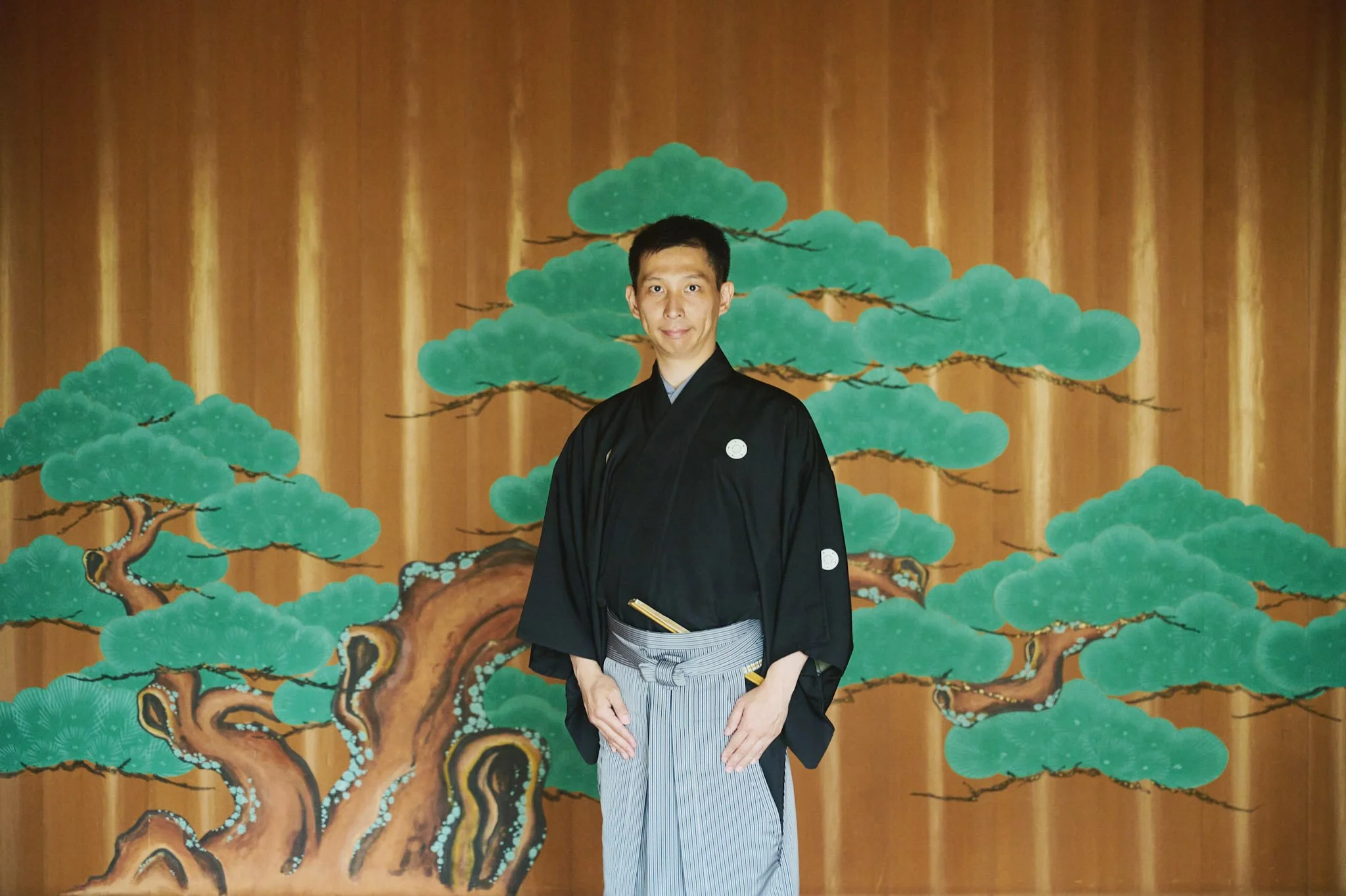
Rhythmic chanting, measured movements, and a stage adorned with a painted pine tree: Noh theater commands attention.
Austere, meditative, and steeped in spirituality, Noh is one of Japan’s oldest performing arts and a recognized UNESCO World Cultural Heritage. Characterized by masks that carry a multitude of emotions within a single carved expression, Noh is thought to form the gateway between the realm of humans and the realm of gods.
Performers possess immense theatrical skills, capable of conveying emotion and narrative through a slight tilt of the mask or the impression of a pose. It takes years of training to reach a level of mastery worthy of performance.
Here, in a private training residence led by Keisuke and his family, Noh’s rich traditions and techniques are passed on to new generations of performers.
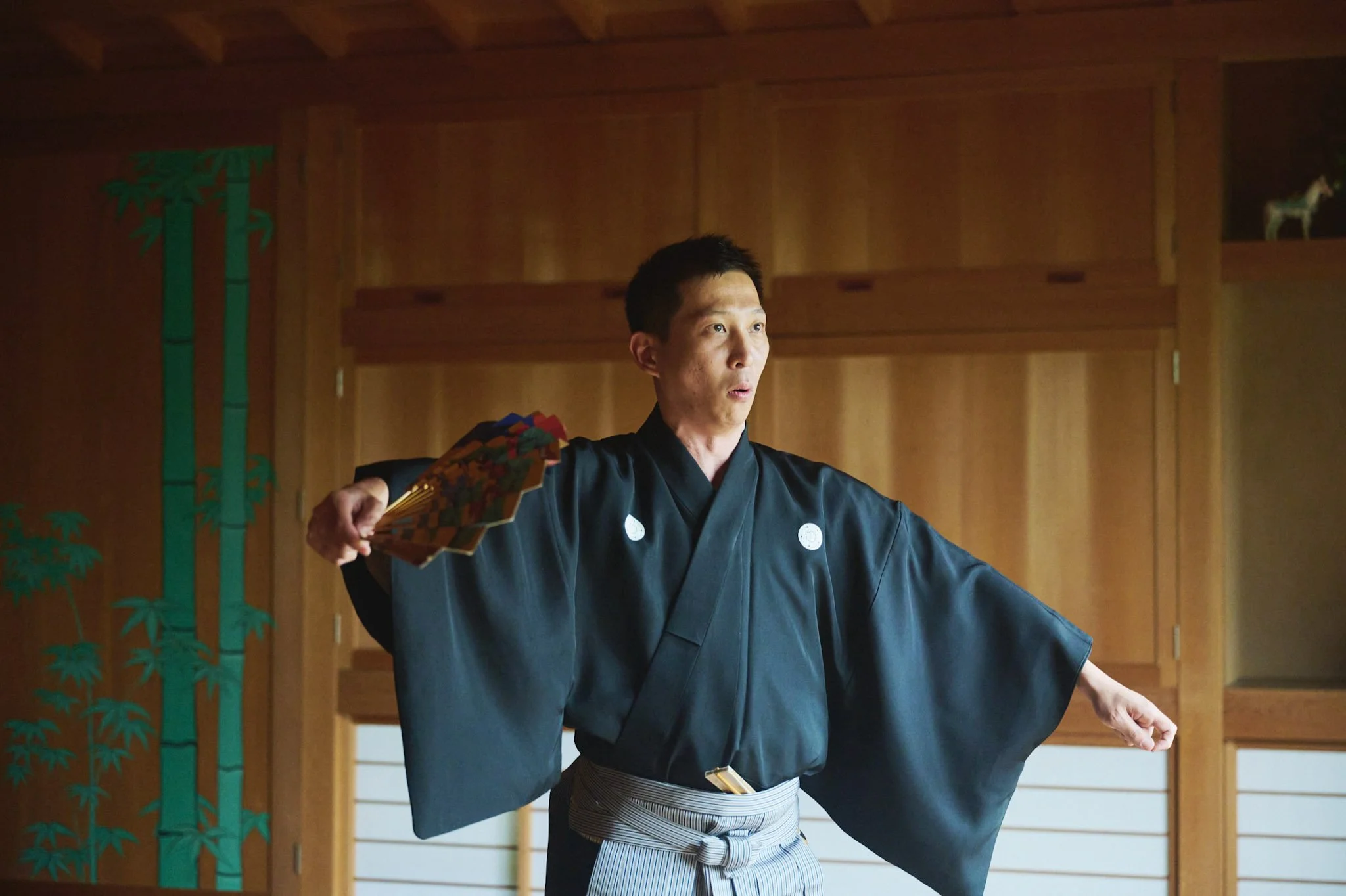
Q: To begin, could you please tell us a little bit more about Noh, specifically the Kita-ryu school?
A: First, let me start by explaining Noh theater.
Noh is a form of musical theater that combines singing and dance, established approximately 650 years ago, during the 14th century, in the Muromachi period. It’s a theatrical art form built around a story, in which human performers portray characters.
There are many people involved in Noh beyond the actors—musicians who perform behind the scenes, as well as the playwrights who create the works. One of the most famous playwrights in Noh history, whom you may already know, is Zeami.
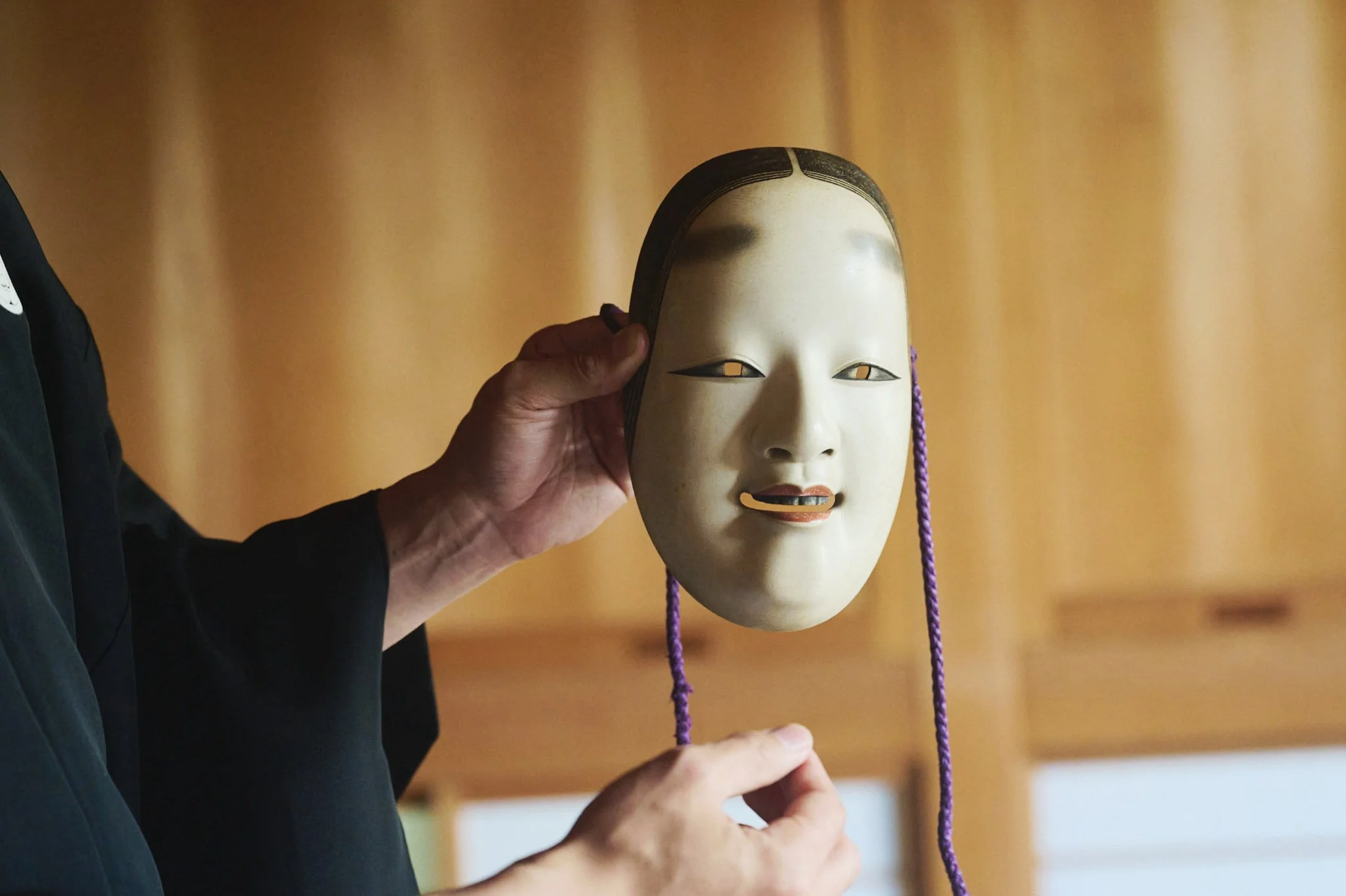
Noh is an art form in which many different disciplines come together: the artistic quality of the script, the artistry of the performers as dancers, the musicianship of the accompanying musicians, and the architectural design of the Noh stage itself, as well as costumes and Noh masks.
Each of these elements is created by highly specialised craftspeople, each of whom brings their own dedication and expertise to their work. All these individual creations come together on a single stage.
Although Noh is ultimately a theatrical performance, the remarkable thing is that each individual element is of such a high standard that it could almost stand as an art form in its own right.
To understand how Noh developed into this kind of art, it helps to look at its historical background. There were people in different periods who were interested in various aspects of performance, but I'd like to explain this by comparing Noh with Kabuki.
Broadly speaking, there are three major differences between Noh and Kabuki.
The first is when they were established.
As I mentioned, Noh emerged during the Muromachi period, approximately 650 years ago. Kabuki, on the other hand, developed during the Edo period, around 300 years ago. There is therefore roughly a 350-year difference between the two.
The second difference is who they were originally intended for.
Noh was originally performed for the gods.
Before Noh developed into the art form we know today, its roots lay in religious ceremonies. Japan was historically an agricultural society, and people performed dances to celebrate a successful harvest or pray for rain.
These performances were originally offerings to the gods.
Over time, members of the privileged classes began watching these performances. At that point, they gradually began to shift from being something offered to the gods to something created for human audiences.
Zeami was instrumental in this transformation. He helped develop these performances into a sophisticated art form intended for an exclusive human audience.
Kabuki developed in almost the opposite direction.
It was created by people who admired these established forms of performance but wanted to make entertainment accessible to as many people as possible. Rather than creating performances for a single privileged individual, Kabuki sought to make theater enjoyable for larger audiences.
This led to developments such as costumes that made performers appear larger and more imposing, musical instruments capable of producing louder sounds, and theaters designed so that more people could enjoy the performance from their seats.
In a sense, Kabuki continued to refine and develop all of these elements to make theater accessible to a wider audience.
The third major difference is their appearance.
In Noh, performers wear masks, known as Noh-men. Kabuki performers, by contrast, use elaborate facial makeup, with the distinctive kumadori style being particularly well known.
Understanding these three differences helps explain what distinguishes Noh from Kabuki.
Returning to the subject of Noh, because it originally developed as a performance for a single privileged audience member, it was not necessarily designed to be presented to large audiences in expansive theaters. Traditionally, Noh was meant to be experienced at a very close distance. You might first examine the details of a Noh mask or Noh costume up close, then step back slightly to appreciate how all the elements came together as a complete performance.
I believe this was much closer to the original way Noh was intended to be experienced.
However, as modern Japan developed, Noh and Kabuki came to be grouped together as traditional Japanese entertainment. Both became established as theatrical performances presented to large audiences in conventional theaters. In doing so, their presentation styles gradually became more similar.
But when you look back at the history of Noh, you realise that it was originally much more personalised. It was an experience tailored to a particular individual: performed in an environment suited to that person, with preparations made in advance based on what they wished to see that day. That was the original style of Noh, and it is something I would like to introduce to more people.
Within Noh, there are five different schools, or traditions, specialising in shite, the principal performers responsible for singing and dancing: the Kanze, Hosho, Konparu, Kongo, and Kita schools.
Among these five, the Kita School is the most recent. It was established during the Edo period and has a history of approximately 400 years. The other schools, by comparison, each have histories of at least 650 years, so the Kita School is the youngest of the five.
One of the distinguishing characteristics of the Kita School is its historical background. Because it was established during the Edo period, it developed at a time when the samurai class held political and social power.
Before that, during the Muromachi period, the Imperial Court and aristocracy had considerably more influence. Even the shogunate was closely associated with the aristocratic class, which played a central role in governing society.
This difference in social background is important.
During the earlier period, aristocrats enjoyed activities such as composing poetry and playing kemari (a traditional ball game) in the gardens of their large residences, sometimes with boats floating in the ponds. Within this environment, traditional Japanese poetry, or waka, became increasingly sophisticated. It developed into renga, or linked verse, which in turn is said to have contributed to the development of Noh.
The Kita School, however, emerged in a period when the samurai class, whose lives were centred around warfare, had become the dominant social group. This next point is my personal interpretation, but I believe Noh also served as a means of mental discipline and concentration for the samurai.
I would really encourage you to come here and experience it for yourself.
Even simply trying to assume the correct posture for Noh requires considerable awareness of your own body. You have to think about keeping your back straight, where to direct your gaze, and how to position your hands. You need to concentrate deeply and become very conscious of yourself in order to achieve the correct, elegant posture.
The costumes also restrict your movement. They are extremely heavy and are secured tightly with numerous cords. Wearing a Noh mask further limits your field of vision.
All of these elements naturally create a situation in which you are forced to spend time confronting yourself.
I imagine this would have been particularly meaningful for the samurai, whose lives were shaped by the constant possibility of being killed by someone else. Living with that fear, they may have found value in becoming more aware of themselves and confronting their own inner thoughts. Through that process, perhaps they could discover something new about themselves.
I believe this was one of the reasons why they found Noh so compelling.
So, although I initially explained the difference between Noh and Kabuki from the perspective of an audience member, there is another important distinction. Whereas Kabuki is primarily something you watch, Noh is also something you practice yourself.
Historically, many members of Japan's upper classes were familiar with Noh not only because they watched performances, but because they also experienced performing Noh themselves. I think this is another important characteristic that distinguishes Noh from Kabuki, and also one of the defining characteristics of the Kita School.
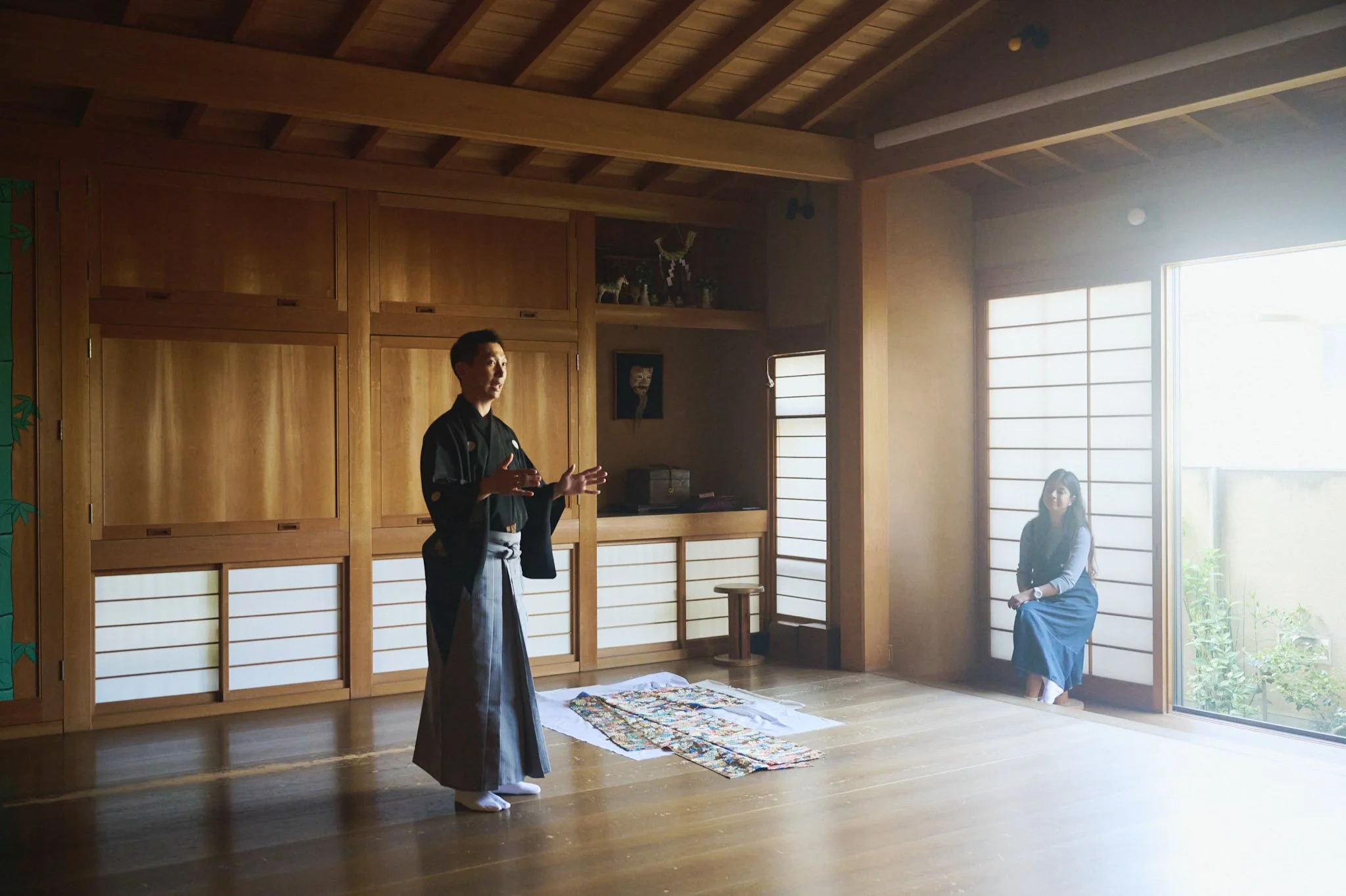
Q: The studio we’re at now seems quite different from a conventional Noh theater, where audiences come to watch performances. Could you tell us more about the space?
A: Historically, the Noh stage was originally an independent structure built outdoors. Over time, roofs were added to cover the entire space, and this eventually developed into what we now know as a Noh theater, or Nohgakudo.
In other words, the Noh stage was originally outside, but it gradually became an indoor structure.
Today, large Noh theaters such as the National Noh Theater have seating capacities of approximately 600 people. Other major theaters in Tokyo generally accommodate between 300 and 500 spectators.
This place, however, serves a very different purpose. It is essentially a dojo, or training hall, where we practice and refine our skills before performing on the stages of formal Noh theaters.
For that reason, almost everything designed specifically for an audience has been omitted.
This stage is primarily intended for us to practice Noh, rather than for people to come and watch it. If you visit us, you’ll be seeing the stage as a place where Noh is performed and practiced, rather than as a conventional viewing space.
The stage itself is surrounded by four pillars and has a traditional roof structure. The floor is made from large Japanese cypress boards, known as yuka-ita, which are laid out in straight lines running towards the front of the stage.
Interestingly, the structure and dimensions of a Noh stage are standardized. Whether you visit a Noh stage anywhere in Japan or elsewhere in the world, the essential construction is the same.
This means that when we practice and refine our movements here, we can go on to perform at any Noh theater knowing that the stage layout and the movements we have trained will be consistent.
That’s the purpose for which this stage was built.
Q: Your father and other members of your family have followed this path for generations, and your father is still practicing today— you yourself began learning Noh at the age of three.
Was there a particular moment, encounter, or realisation that made you decide to continue in this profession, and what continues to motivate you today?
A: I suppose that, from the moment I became conscious of my surroundings as a child, I was already living in a house that had a Noh stage inside it.
In fact, I was so accustomed to it that I assumed everyone had a stage in their home. I thought having a Noh stage on the first floor was just as ordinary as having a bathroom or a toilet.
So, initially, it didn't seem particularly unusual to me.
It was only after going to school, talking with friends, and visiting their homes that I gradually began to realise that our house was rather different.
I made my first stage appearance at the age of three, performing as a child actor, a role known as kokata.
The role of kokata actually has two distinct purposes.
The first is to portray a child. Naturally, there are certain roles that only an actual child can convincingly perform, regardless of how skilled an adult actor might be. When a child character appears on stage, that role is performed by a kokata.
The second is to portray someone of exceptionally high status, or someone renowned for being extraordinarily handsome or beautiful. These roles are also performed by children.
There is an interesting reason for this tradition.
Imagine characters such as the Emperor, Minamoto no Yoshitsune, or Hikaru Genji. These are figures who are traditionally considered exceptionally handsome, beautiful, or distinguished in status.
If I, as an adult performer, were to portray one of these figures realistically, some audience members might inevitably feel dissatisfied. They might think, "That isn't how I imagined him," or "He should look different."
This is something that happens quite frequently with film adaptations of novels. When reading a book, we create our own image of an exceptionally handsome man or beautiful woman. When the story is adapted into a live-action film, the casting may not match the image we had imagined, leaving us feeling that something is not quite right.
The Japanese had already considered how to avoid this problem some 700 years ago.
By having a child portray an adult character, the performance leaves room for the audience to imagine that person as an adult in whatever way they wish.
This is an important aspect of Noh's aesthetic philosophy.
As a result, when I was young, I was given the opportunity to perform all kinds of impressive and interesting roles, not just ordinary child characters.
I genuinely enjoyed it.
I was able to play characters who were treated with great respect on stage. Afterwards, people would praise me, and I would sometimes be rewarded with toys. It was almost like a dream life. At that age, I never really questioned it.
However, when I reached around my third year of junior high school and first year of high school, my training towards becoming an adult performer began in earnest.
From that point onwards, I was hardly ever praised.
There was an enormous amount to learn, and the training became extremely demanding. It was very difficult, and there were many times when I wanted to give up and run away. There were several reasons why I ultimately decided to continue.
One of the most significant experiences happened when I was still at the very bottom of the hierarchy and was taken overseas for a performance.
After the show, I noticed an elderly French woman who remained in her seat, crying. She didn't speak Japanese at all. Through an interpreter, I learned that she had been deeply moved by the performance and that it had touched her heart in a profound way. That experience made me realise something important.
Noh can communicate with people on a level that goes beyond language. Its text and vocabulary can be difficult even for Japanese audiences to understand, yet it still has the potential to move someone who faces a complete language barrier.
In a world where we are constantly discussing globalization, international relations, and the difficulty of overcoming cultural and linguistic differences, I realised that this art form possessed a very special quality.
I don't necessarily think of what I do every day as art, but that experience made me aware of another dimension to it.
There have also been other experiences, although some are not particularly easy to talk about.
For example, I have seen people suffering from illnesses that modern medicine cannot cure come to watch Noh performances. Afterwards, some have told me that they felt better than they had in a very long time.
There is something about this art form that can reach people in unexpected ways, beyond what can be explained through purely scientific or rational thinking.
I find that extraordinary power deeply compelling.
Another reason I have continued is the experience of watching my seniors perform as I work towards becoming a Noh performer myself. These seniors are not necessarily just my father or my own teacher. They include performers from other schools as well.
There are moments when I watch someone on stage and catch a glimpse of something extraordinarily radiant. It is difficult to describe, but I sometimes think of it as something like an astronomical alignment. Not a constellation, but an alignment of celestial bodies, like the movement of stars.
Even if I am deeply moved by something, I cannot necessarily make another person feel the same way. I might say, "Wasn't that incredible?" and they might respond that they didn't notice anything special.
Conversely, someone else might be moved by a moment that left me completely unaffected. It is almost as if the sun, moon, and Earth suddenly align in just the right way, allowing a beam of light to pass through somewhere it normally could not.
I feel that something similarly extraordinary can happen between the performer, the audience, and perhaps something else beyond the two of them. There is an immense power in these moments that cannot be explained in words or reduced to a simple, logical understanding.
It may be something I spend my entire life pursuing without ever fully reaching it. Perhaps I will never experience it again.
But then, unexpectedly, I might feel that it has happened once more, like seeing a shooting star.
That is part of what makes Noh so fascinating to me. I keep performing because I want to experience that feeling again, and I hope that someday I can help someone else experience it, too. That is one part of what motivates me, even though it is difficult to put into words.
There is another reason: I think of my family as being a little like a relay team.
My grandfather carried the baton, and my father inherited it from him. Now my father is in the process of passing that baton on to me. At the moment, we are still running alongside one another. If I were to retire or give up, it would feel as though all the runners who came before me would have to stop as well.
I don't know whether I will be able to improve the time set by those who came before me. Perhaps I might stumble somewhere along the way and actually make things slower. But regardless, I have to keep carrying the baton and pass it on to the next person.
That person might be my son, or it might be someone completely different, a younger colleague or successor. Whoever it is, I feel that I have a responsibility to pass it on to someone. I suppose that sense of responsibility is what keeps me going.
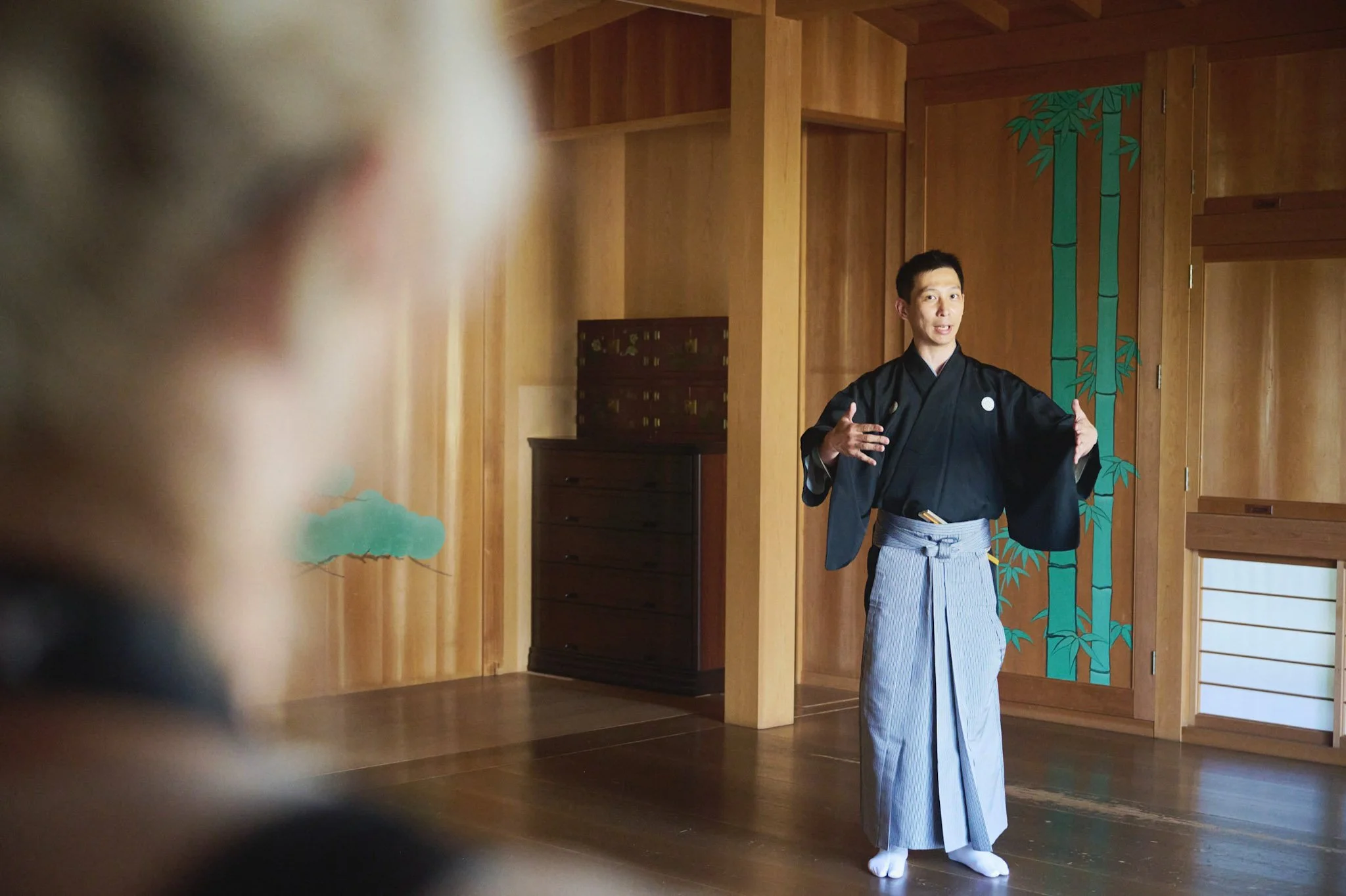
Q: There are many different ways of appreciating Noh, and perhaps describing it simply as a comprehensive art form doesn't quite capture everything it encompasses. From your perspective, what would you particularly like visitors to remember or feel after spending time here?
A: When Noh first emerged and began to develop, Japan was made up of many different provinces and territories. The country had not yet been unified under a single ruler.
When we consider this historical background, I don't think it is particularly meaningful to approach Noh by asking which country someone comes from, which cultural sphere they belong to, or which religion they follow.
Noh is deeply connected to natural phenomena and the fundamental experiences of being human. These are things we can all understand, regardless of our ethnicity, skin color, or religious beliefs.
For example, everyone understands what it means to feel hungry. We all care deeply about our children and parents. If someone close to us passes away, we feel sadness. When flowers bloom, we think they are beautiful.
When the sun rises after a long night, we feel a sense of relief. Similarly, when the sun sets, we feel reassured that another day has passed safely.
I think Noh explores these kinds of universal human experiences on a very fundamental level.
For that reason, I don't believe visitors need to approach it thinking that Japanese culture is something they must study or understand intellectually before they can appreciate it. In fact, I would like Japanese audiences to approach it with that same openness. Japanese people, myself included, sometimes feel an unnecessary sense of embarrassment or inferiority when we encounter something and realise that we don't fully understand it, despite being Japanese.
In my experience, children and international visitors are often much better at appreciating Noh intuitively. They tend to approach it with a greater sense of curiosity and sensitivity.
I would really like people to come and experience Japan without feeling that they need to prepare themselves extensively or approach everything with excessive formality.
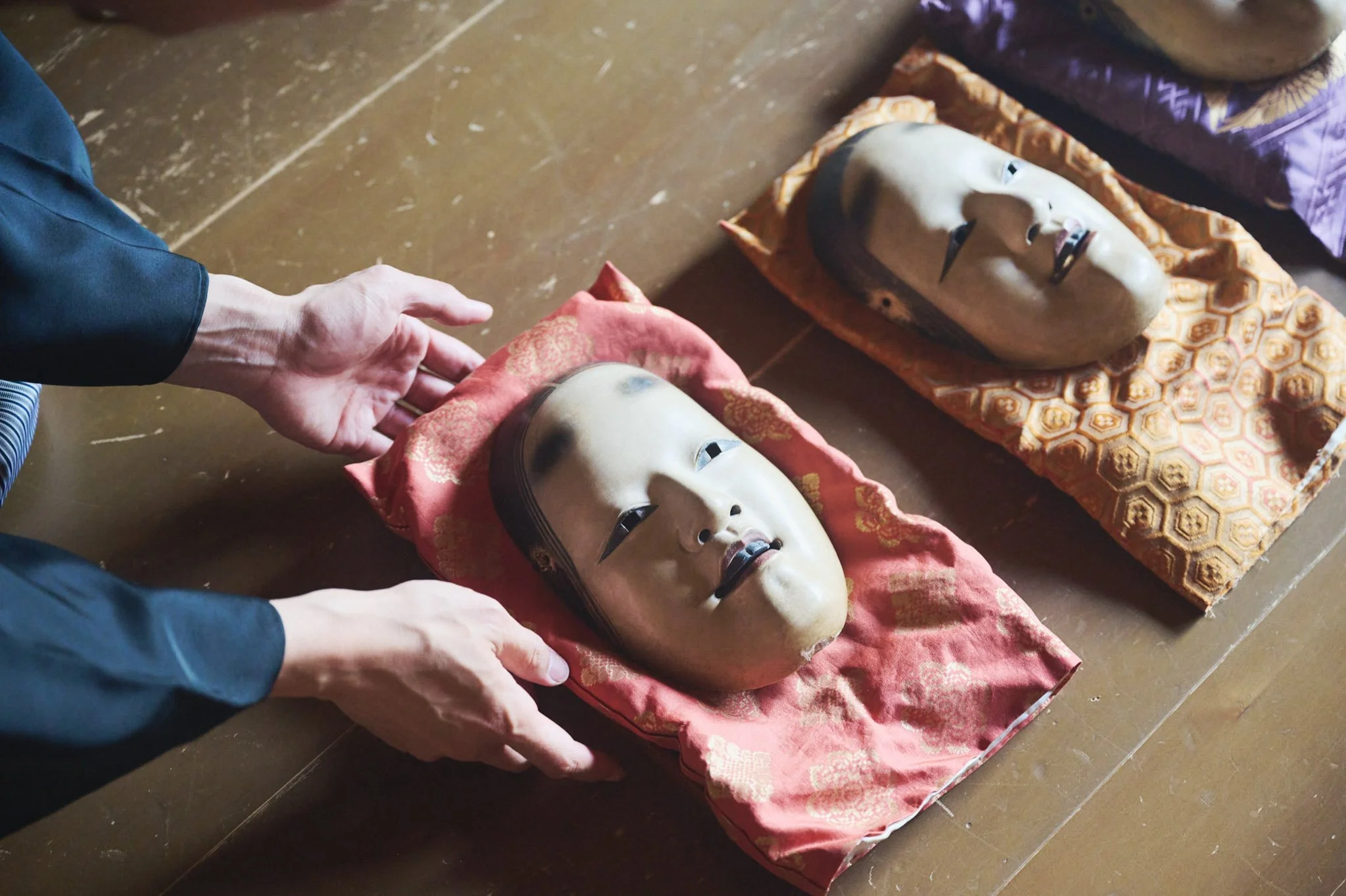
At the National Noh Theater, for example, there are performances almost every day, and many include English subtitles so that international visitors can follow the story. Watching one of these performances is certainly a good way to experience Noh. However, as I mentioned earlier, Noh masks and costumes were originally intended to be seen from a much closer distance than is possible in modern theaters. Today, audiences often have to watch from quite far away.
There are certainly aspects of Noh that look beautiful from a distance, but I also think there is something special about observing the small marks and imperfections that have accumulated over the centuries. You can notice areas where the colours have changed or where the materials have been worn down through years of use. Even this stage, which might look beautiful and pristine from a distance, is covered in countless small scratches.
I have practiced here for so long that many of those marks carry personal memories for me. I can look at certain scratches and remember exactly when they appeared.
These are details that you might not necessarily need to see, but once you become aware of them, they can reveal an entirely different dimension of the experience. In that sense, Noh is often perceived as something distant or difficult to understand. But those of us who practice it are simply human beings, too. We eat the same food, breathe the same air, and drink the same water as everyone else.
I'd much rather people feel that they can come here casually, almost as if they were visiting someone's home.
I want them to see Noh, learn about it, and experience it firsthand without feeling intimidated.
Afterwards, they might choose to watch a performance at a Noh theater, or explore another aspect of Japanese culture. When they do, I believe they will begin to notice a remarkable number of connections. For example, wood expands when it absorbs moisture and contracts when it dries. This natural characteristic has influenced the way Japanese furniture, such as traditional chests, and tea utensils are made.
There are many similar principles hidden within Noh that can provide a useful reference point for understanding Japan more broadly. When people visit Japan, I hope that an experience like this can give them a new way of looking at the country.
Through this experience, they may discover aspects of Japan's beauty that even Japanese people themselves have sometimes lost sight of.
For people from countries with different religious traditions, certain beliefs and customs may simply feel like an unquestioned part of everyday life. But taking a step back and looking at those beliefs from a broader perspective can be an interesting experience.
Perhaps that sounds rather ambitious, but many conflicts around the world ultimately arise from differences in ideology and belief. I think there is value in stepping back and looking at these things from a wider perspective, while still retaining the beliefs and values that are important to you. Noh contains an enormous amount of accumulated history, philosophy, and human experience.
I would be delighted if visiting this place could become an opportunity for people to reflect on some of these things and discover something meaningful for themselves.
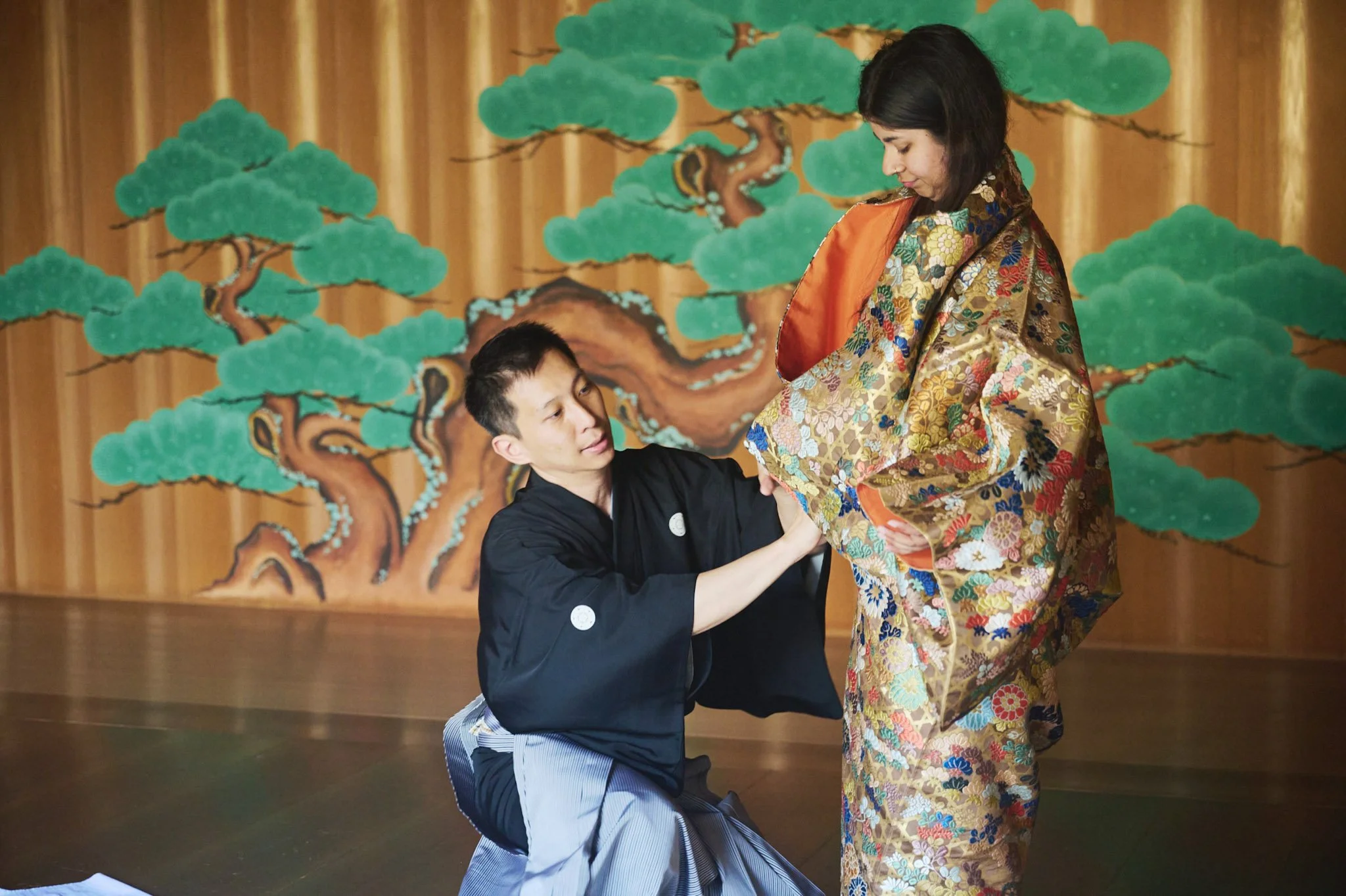

Step onto the stage and experience the drama of Noh theater, a centuries-old art
Step inside a private Noh training hall and discover a 650-year-old performing art through the eyes of a master of the Kita School, whose family has practiced the tradition for generations. Explore the intricate beauty of Noh masks, costumes, music, and movement, while learning how this art form reflects Japan's history, philosophy, and approach to life.
Meet a fourth-generation Noh performer, step onto the stage where he has spent a lifetime practicing, and experience the discipline and artistry behind one of Japan's most enduring theatrical traditions.
Meet More Masters
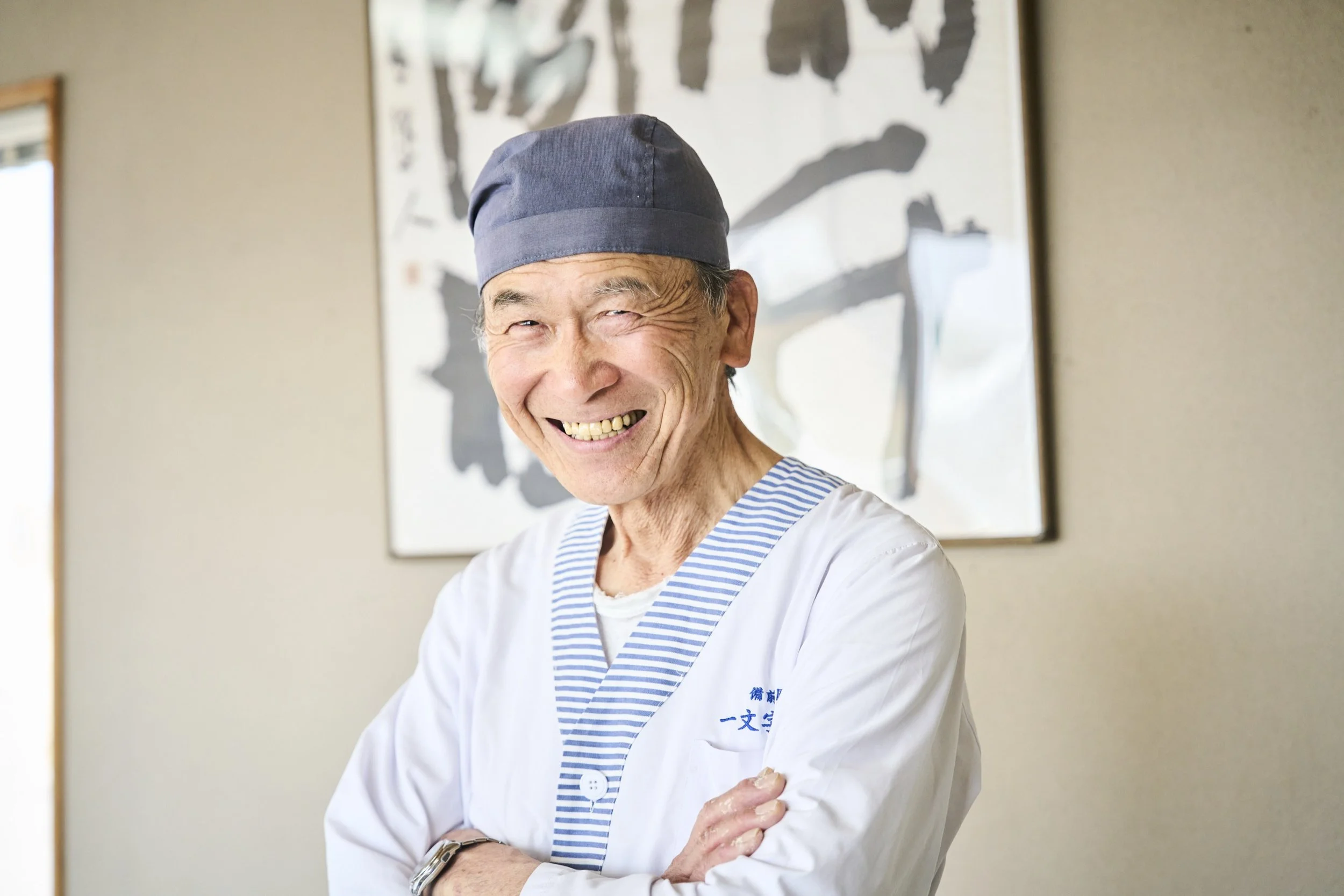

Discover Cultural Experiences


Get right next to the action and observe an authentic sumo training session