
Meet Chikara, Aji Granite Artisan
“I think my ultimate way of giving back to this region is that in the future when people think of stones, they think of Kagawa Prefecture, and when they think of Takamatsu, they’ll think of stones. ”
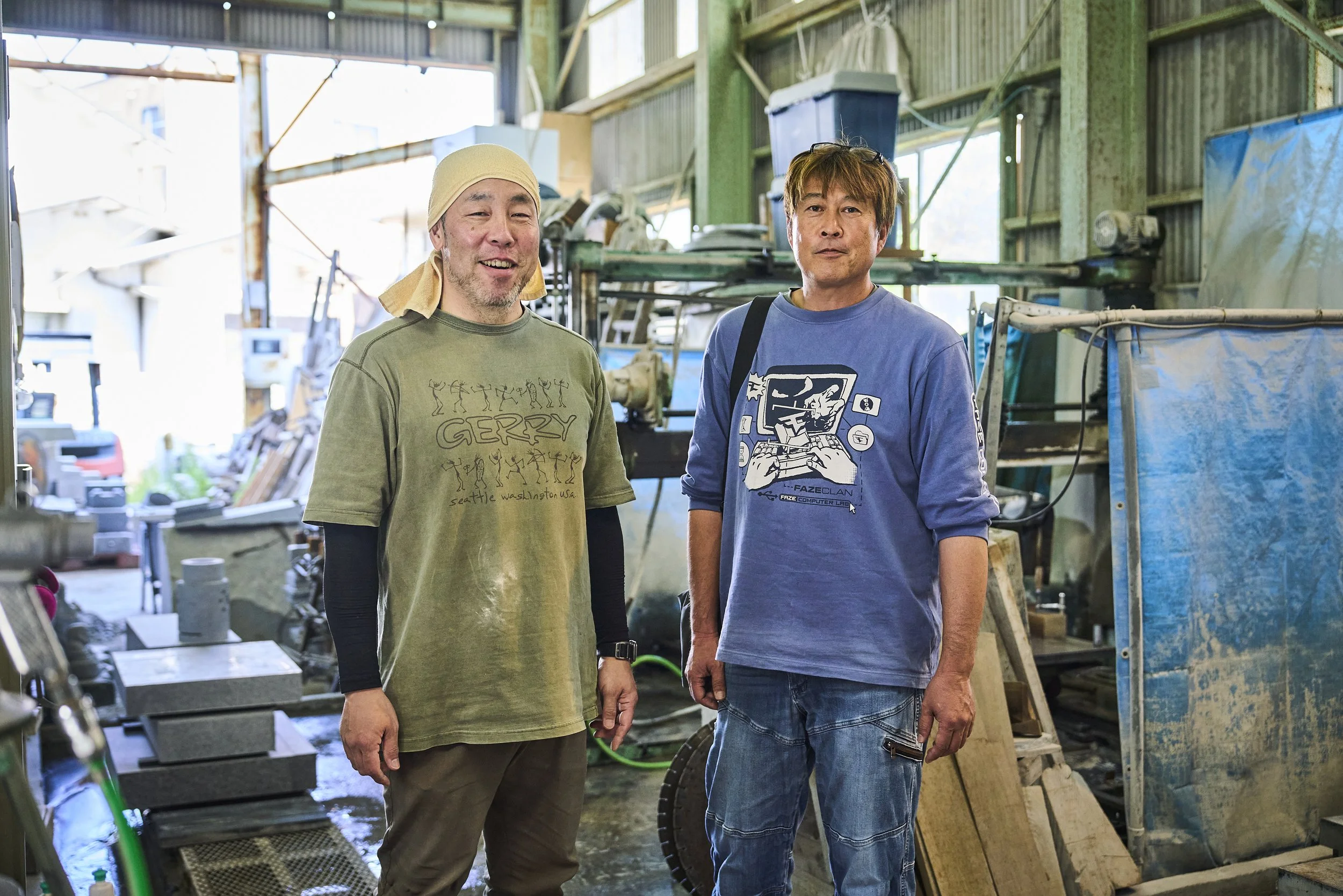
Known famously around the world as the “diamond of granite,” Aji granite is praised for its beauty, durability, and irreplicable pattern.
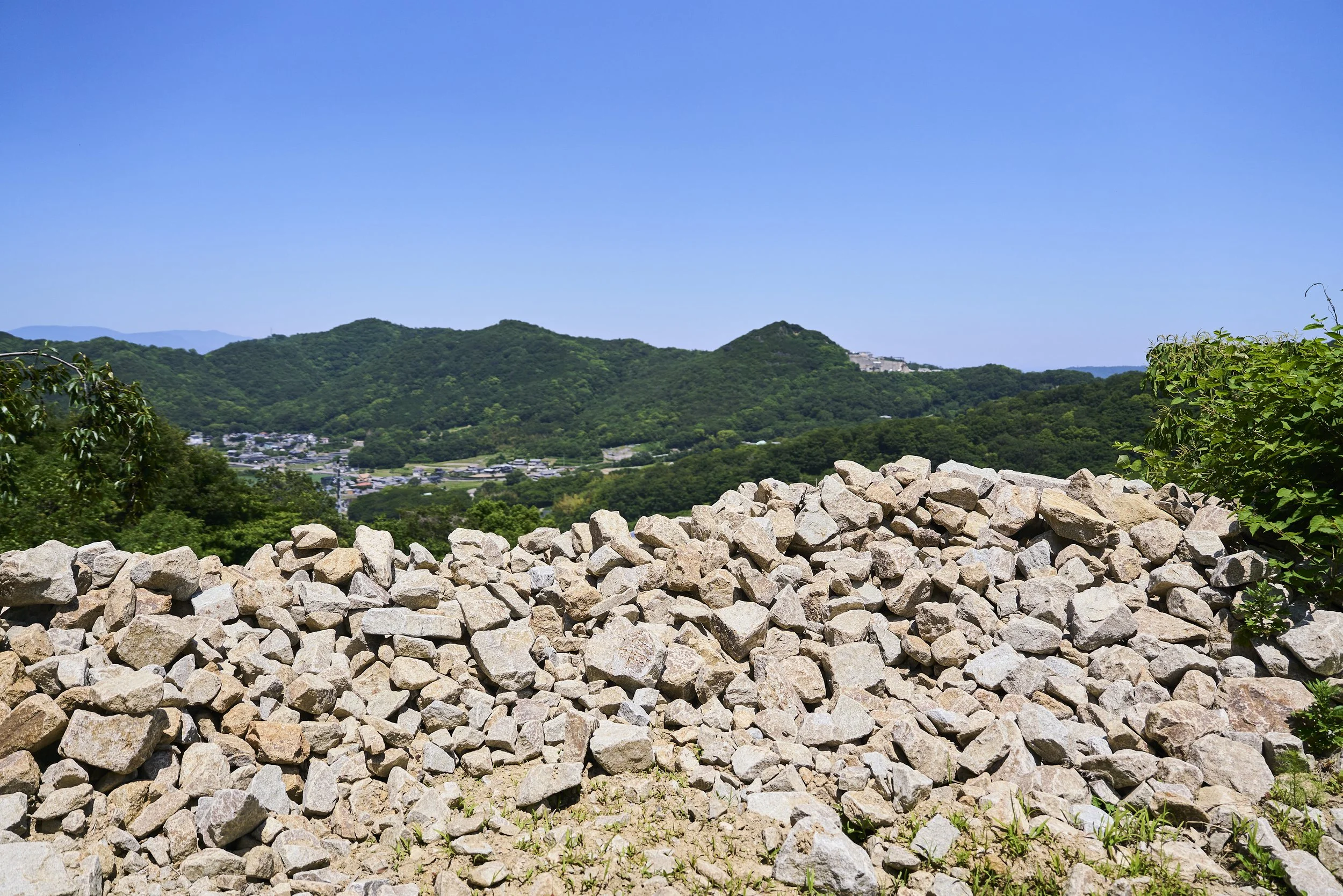
The mountainside quarry offers sweeping views of the towns below, the deep blue of the Setouchi Inland Sea beyond it, and finally, the expansive blue of the sky above.
On the eastern side of Takamatsu City stands Mount Goken, from where Aji granite has been recorded to have been quarried since the end of the Heian era, with the first earnest quarrying occurring in 1588 with the construction of Takamatsu Castle.
Utilizing this quarrying location, Chikara-san’s company has extracted stone to craft and design stone-based products other than gravestones, in order to preserve the skills and techniques of stone masonry through new and innovative methods.
Join Chikara-san in the foothills of Mount Goken to learn more about the history of Takamatsu as the Aji granite production region, as well as a center of local crafts.
Q: Can you tell us more about yourself, the studio, and what the concept of your company is?
A: Around 32 years ago, I founded this company.
I had originally wanted to be a high school physical education teacher, because I’d been practicing judo since I was a kid. I even went to college on a judo scholarship, but I had to quit halfway through and come back home because I got injured.
My father came from Ehime Prefecture to Takamatsu City, where he worked at the quarry as a mountain stonemason.
Because the rock was layered, eventually there was no more stone to extract. So, once the stone ran out, he wondered how much money he’d have to pour into it to get more stone out of there, and whether the amount of stone he’d extract would even cover the investment. After agonizing over that, he decided to close the business. That was when I was 10 years old. So, I can say that for a brief moment, my family was in the stone masonry business.
I never really intended to go into the stone masonry business in the first place, but after I dropped out of college and came back home, I was wondering what to do. I realized I wasn’t the type to put on a tie and work a regular job, so even if it was just a small operation, I had this desire to be my own boss. I think I was about twenty at the time.
I went to apprentice at a stone masonry shop, where I trained for nearly four years before launching my company.
This industry is divided into specialized roles based on the local production area, with various tasks like quarrying stone from the mountains, polishing it, and sculpting it into shapes. There are even specialists in creating stone lanterns. Among various areas of expertise like engraving, installing, and transporting, I trained for nearly four years as an engraver and had my company specialize in that for almost 30 years.
This new company was established in 2021, but back then, the industry was primarily focused on the gravestone market, which was already in a state of significant decline.
There are many skilled craftsmen in this region and because of the division of work, they each have a high level of specialization where they all focus intensely on a single craft, so their technical skills are exceptionally high.
However, due to the decline of the gravestone market, these highly skilled artisans have been forced to leave the trade one after another. Being an artisan isn’t something you can learn in just a day or two; after all, everyone spends years mastering their craft. The reality now is that the skills they’ve spent years acquiring are becoming completely useless in the future.
This region is said to have a history of about 1,000 years as an Aji granite production center. In the oldest documents, perhaps from the Heian period, it is said that stones were transported from the Aji quarry area towards Kyoto. After the war, ordinary people were able to build their own graves, but after the past 100 years or so, stone masons are still synonymous with gravestones. They are probably the only hit product in the stone industry over the past 1000 years, but now these are in decline, even though the artisans’ skills are exceptionally high and the granite quarried here has long been regarded as the highest quality in the world.
It is very painful to see this production area wither away, so we decided to take our skills and apply them to markets outside the gravestone industry, and launch new products. That’s why we established this company in 2021.
We used to hire designers on a one-off basis for six months or a year, but now we’re taking a different approach: we began hiring designers on an ongoing basis, and then brought in a director after about a year. Currently, we have an international lead designer and a director from Switzerland, and since the end of last year, we’ve brought on about 10 new designers—four from Europe, four from Japan, and two from South Korea.
We’re taking these steps to start expanding into overseas markets. So, even though we’re a traditional stone company, this company is operating in ways that go beyond the typical stone masonry business.
Q: How do you plan to advance this company and region from now on?
A: First of all, this company isn’t actually in the stone industry at all. After all, when you hear “stone” inevitably brings to mind gravestones, so we launched this new company specifically to break away from that image.
So, how can we reach out to the world? We’ve clearly decided who to work with and what our goals are, and now, as a team— including designers, directors, and artisans— we’re all working together as one unit.
So, what is my ultimate goal in doing this? One major reason I’ve been able to continue as a business owner is thanks to Aji granite and the Aji region. One of my goals is to find a way to give something back for that. So, when I ask myself what that might be, it ultimately comes down to “stone.”
For example, when you think of eyeglasses, you think of Sabae; when you think of knives, you think of Seki; and when you think of towels, you think of Imabari.
But when it comes to stone, I don't think there is anything that comes to mind for everyone, so if we can associate stone with Takamatsu City in Kagawa Prefecture, that would be great. It’s a place with a truly wonderful history behind it that should be recognized.
Back in the 1960s, famous sculptors worked or settled here, such as Isamu Noguchi, with his atelier, and Nagare Masayuki. Also, unrelated to stone or sculpting, George Nakashima, a renowned furniture maker and designer, worked on his craft in Takamatsu City as well. There may not be any other place in the world where such artistic greats from the same era gathered in one place at one time. At this time, the city also introduced cross-industry networking events, which greatly expanded the craft of Kagawa Prefecture to the world.
By combining these elements, I believe we can promote Aji granite, as well as this town of stone, even further. I think my ultimate way of giving back to this region is that in the future when people think of stones, they think of Kagawa Prefecture, and when they think of Takamatsu, they’ll think of stones. If I could do that, I would really feel like I could die without regret. We are currently undertaking various initiatives in this company towards that goal.
Q: For guests wanting to come out to the mountains and engage in this unique experience, what would you like them to take away from coming here, especially those from overseas?
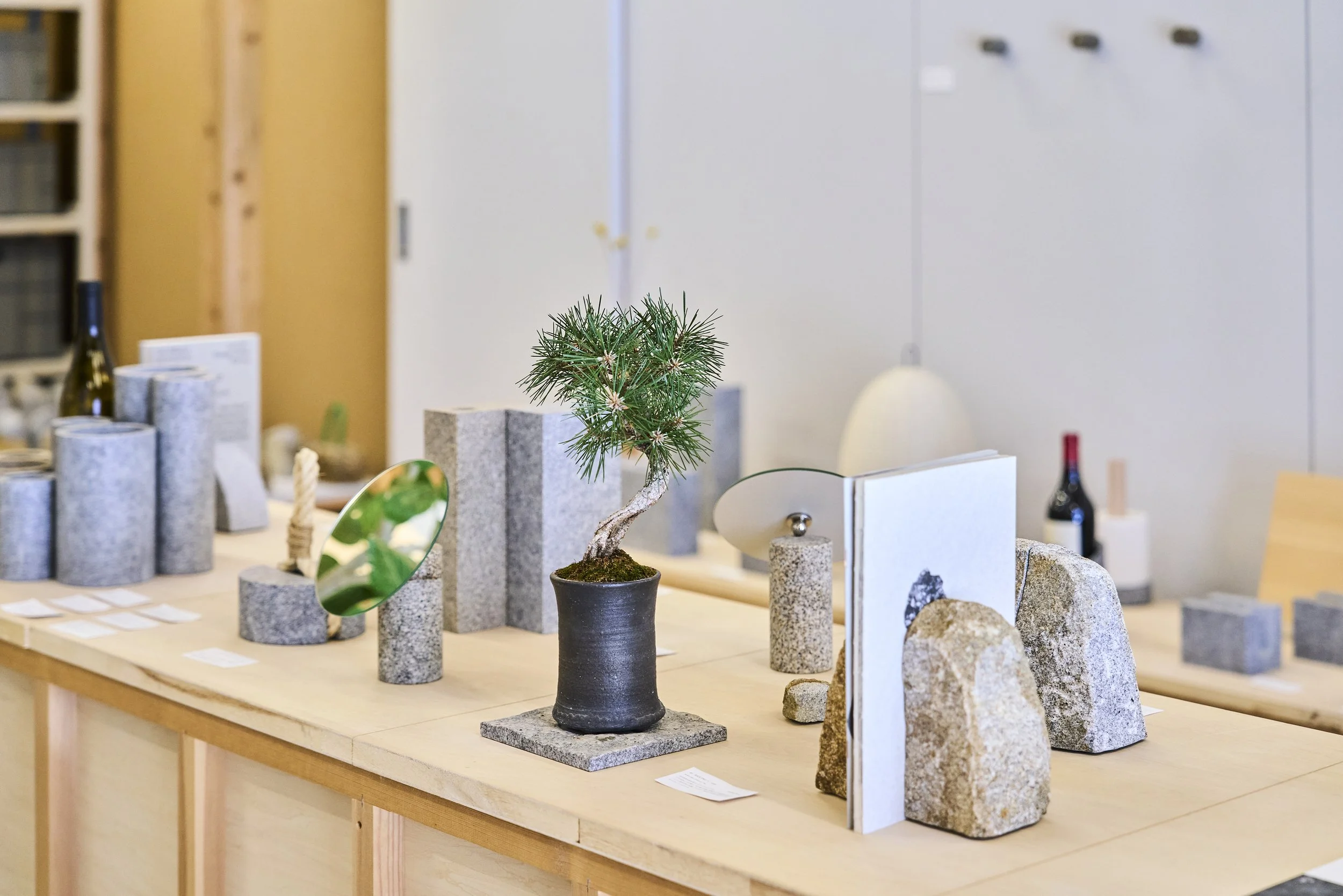
A: What we have here in the shop are finished products. As I mentioned earlier, this region operates on a division of labor, so various craftsmen are involved in creating a single item.
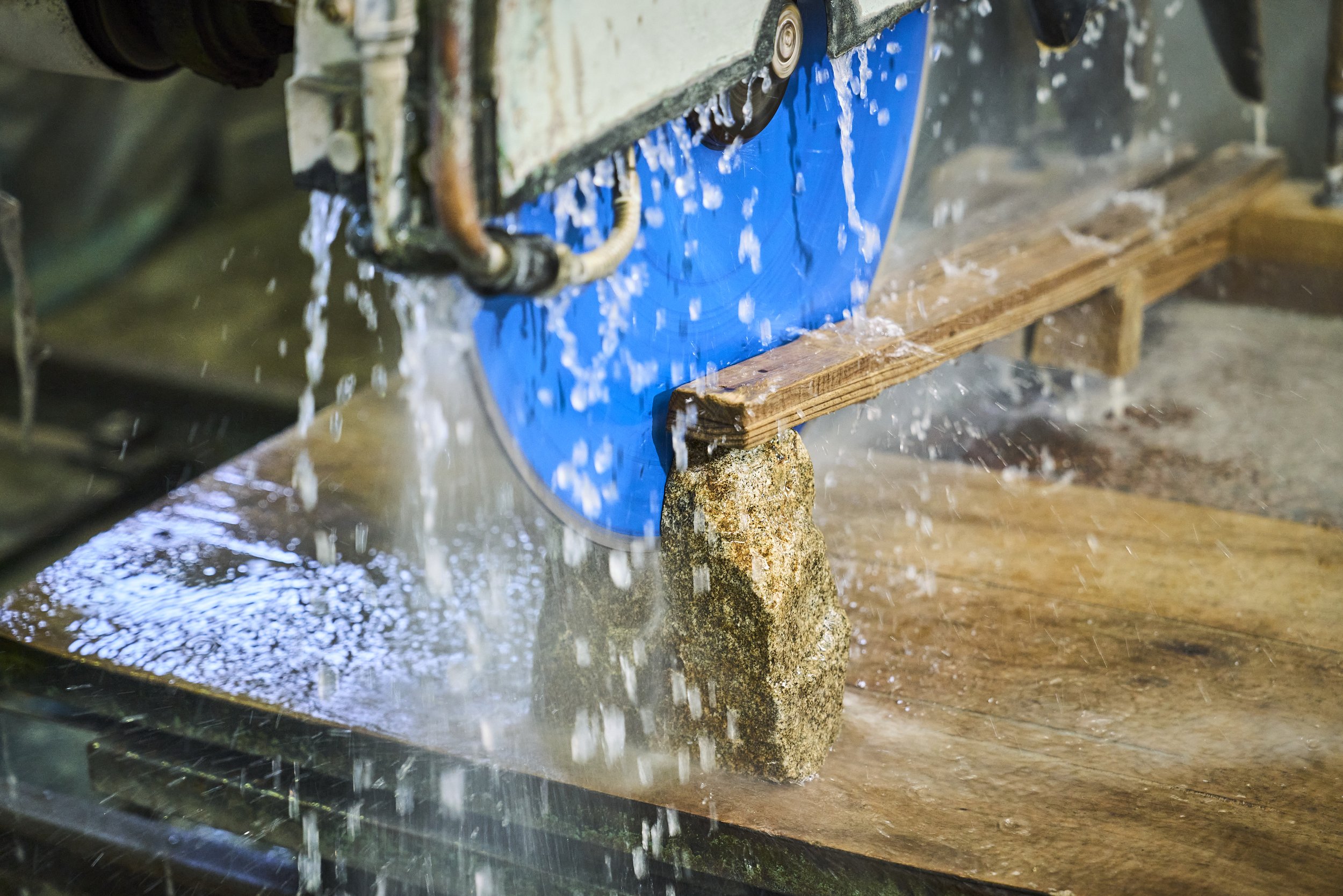
Regarding the items placed here, of course, there is a price attached. However, to help our customers decide for themselves whether the price is high or low, we want to show them the process of how these items are made.
Quarries in particular are places that the general public usually cannot access. By coming here, you can see the scenery, feel the breeze, and experience the heat and cold. I would be very happy if you could think of that product as a piece of art.
This is a unique stone that can only be found in this one-of-a-kind place. Hence, I believe this is an experience you likely can’t have anywhere else, so I really hope you’ll enjoy that aspect of your visit. Whether you’re from overseas or within Japan, if taking one of these stones home helps you recall this scenery, I would be truly grateful.
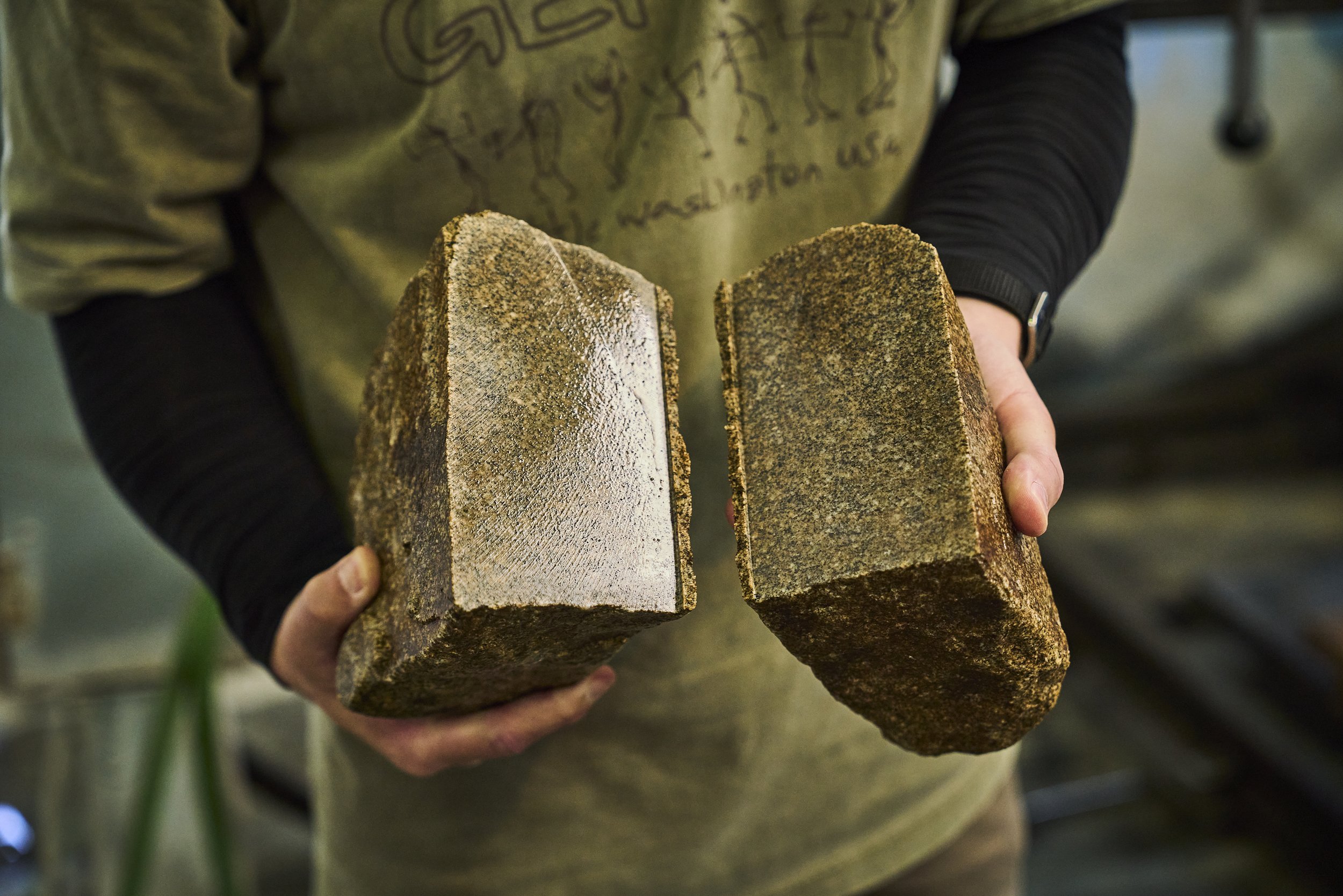
Experience the journey of Aji granite, from mountain face to artisan's hands
In the foothills of Takamatsu, Chikara-san sincerely welcomes all visitors to his company’s workshop to see hard work and dedication towards a local craft older than a thousand years. See how rugged stones can be turned into beautiful household objects for everyday use.
Step into Chikara’s stone masonry workshop and get a glimpse into the production process of this ancient Shikoku tradition.
Meet More Masters


Discover Cultural Experiences


Get right next to the action and observe an authentic sumo training session