
2000 Years of Destruction & Rebirth: Natural Disaster in Japan
The cycle of natural disasters and reconstruction is as old as Japan itself, telling a story of both destructive calamity and determined repair.
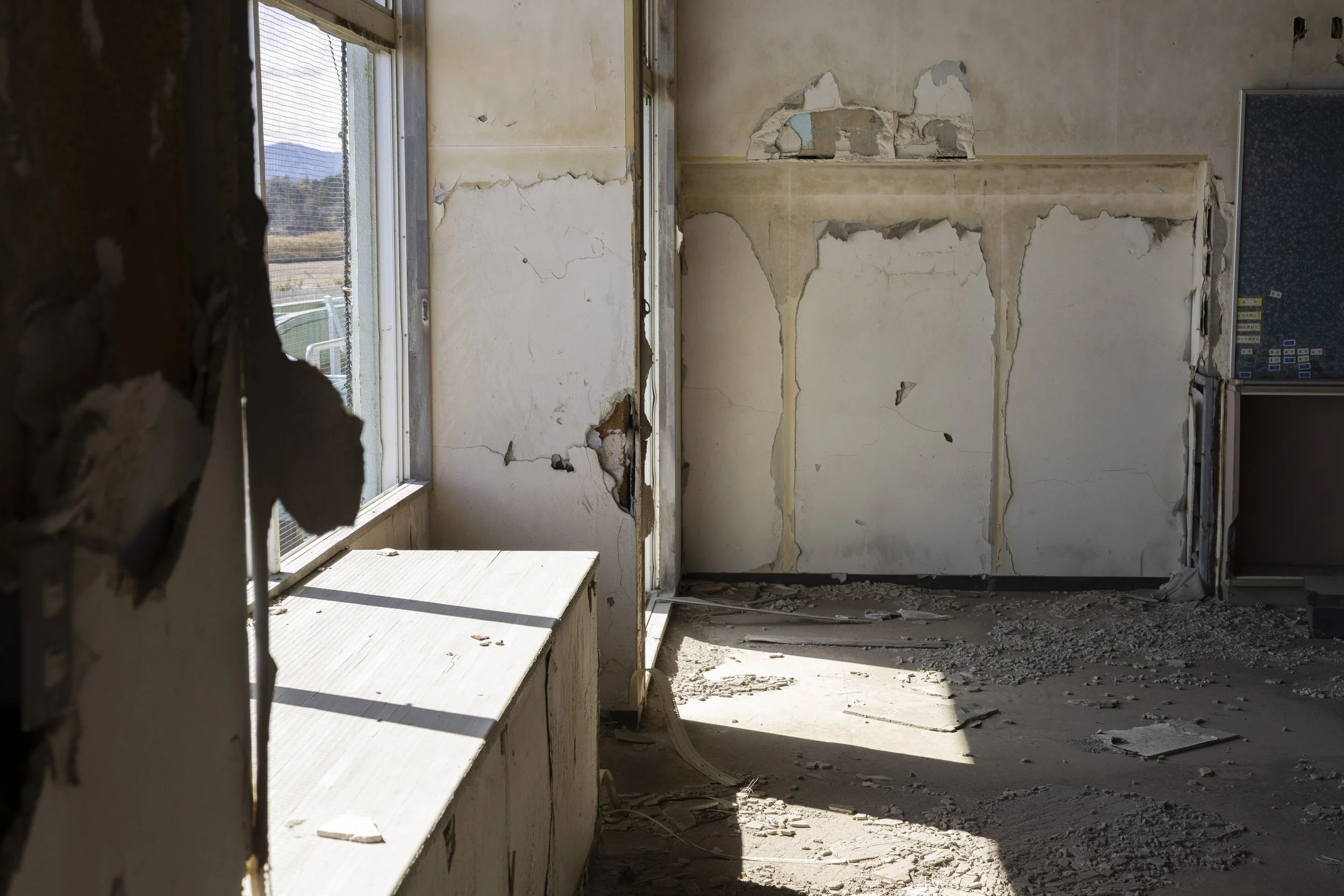
Ukedo Elementary School Memorial Museum in March 2026. Photo by Thomas Shomaker
15 years after the tsunami, the remains of Ukedo Elementary School have become an open-air memorial in the emptied-out coastal region of Namie, Japan. Surrounded by barren plains that used to be filled with homes, the ruins of the school, 300 meters from the shore, are a vivid reminder of the scale of the Great East Japan Earthquake of 2011.
As one of the world’s most seismically active countries, disaster and reconstruction are embedded in Japan’s history. Traditionally reliant on wood as a building medium and prone to high winds, fires–related to earthquakes, war, or accident–have periodically swept through cities and towns, inspiring precautionary rituals that are still alive across the country today. Such practices and mitigation efforts for earthquakes and tsunamis have developed over Japan’s history, both aided and hindered by technological advances.
In fact, even our starting point for established Japanese history was determined by fire. In 645 CE, the future Emperor Tenji, acting with four confederates, attacked and killed an imperial advisor during a court ceremony. As the second-oldest book known to exist in Japan, the Nihon Shoki (Chronicles of Japan), explains, the victim’s father (also an important official) was so distraught by his son’s murder that he committed suicide by setting fire to his residence. The conflagration destroyed a 620 CE text called Tennoki, or Record of the Emperor, among other documents, rendering most ancient Japanese history as legend and conjecture, not established fact.
But while we can’t see how Japan dealt with calamities before the 7th century, its history since is one of increasingly sophisticated responses, even as its population exploded and the scale of its disasters increased.
Another Tsunami is Coming
While tsunamis can strike anywhere along Japan’s coastline, most originate along two Pacific Ocean tectonic convergence zones: the Nankai Trough off Japan’s southern coast and the Japan Trench, which runs roughly parallel up Japan’s northern coast from Tokyo past Hokkaido. A megathrust earthquake along the Nankai Trough in 684 CE caused the first historically confirmed tsunami to strike Japan, impacting what is today’s Wakayama Prefecture and the island of Shikoku. Along the Japan Trench, the first confirmed tsunami to impact the Tohoku region–site of the 2011 inundation–was caused by the 869 Jogan earthquake.
In the 1,200 years since, dozens of tsunamis have periodically ravaged these areas. But many of these inundations were separated by many generations, and until recently, complacency often set into seaside communities.
This began to change on the morning of June 16th, 1896, when returning fishermen found that their villages along Tohoku’s coast were no longer there. A devastating tsunami had struck the evening before, killing an eerily similar number of people as would be lost 115 years later and originating in about the same area as the catastrophe in 2011. Villagers along the coast had felt the earthquake, but were preoccupied with a Shinto festival and celebrating soldiers’ victorious homecomings from the First Sino-Japanese War. About 35 minutes after the tremors, the first of two waves struck. A monument to the Meiji Sanriku Tsunami, as it came to be called, still stands in the town of Ofunato’s Ryori neighborhood in Iwate Prefecture, its inscription speaking to the brutality of the waves.
In Ryori, the victims were found with fractured skulls, broken legs or without arms.
Despite the lack of tsunami preparedness, the disaster response was efficiently modern. News arrived via telegram to the Interior Ministry the following day, with inspectors, military police, and engineers arriving shortly at the scene, along with three warships offshore tasked with body recovery. The aftermath also saw a proliferation of “tsunami stones” across coastal Japan–simple stone monuments reminding future generations of tsunami danger. Despite already having existed as a cautionary measure for over 600 years, these stones were popularized after the 1896 disaster. Although rendered obsolete by modern warning systems, these stones can still be easily found in coastal cities today.
Following another tsunami in the same area in 1933, local governments began developing preventative measures, like tide embankments, to stave off harsh waves or buy more time for citizens to flee. Municipalities also designated escape routes, publishing pamphlets outlining tsunami safety practices. In 1941, Sendai City debuted the first tsunami warning system, capable of making predictions via seismic wave amplitude and distance from the epicenter. This system became country-wide in 1952, and as a result of periodic upgrades, the time between tremors and a tsunami forecast progressively reduced. The 2011 tsunami warning was issued a mere three minutes after the earthquake. But in coastal areas like Sendai, residents still had only about 10 minutes to evacuate.
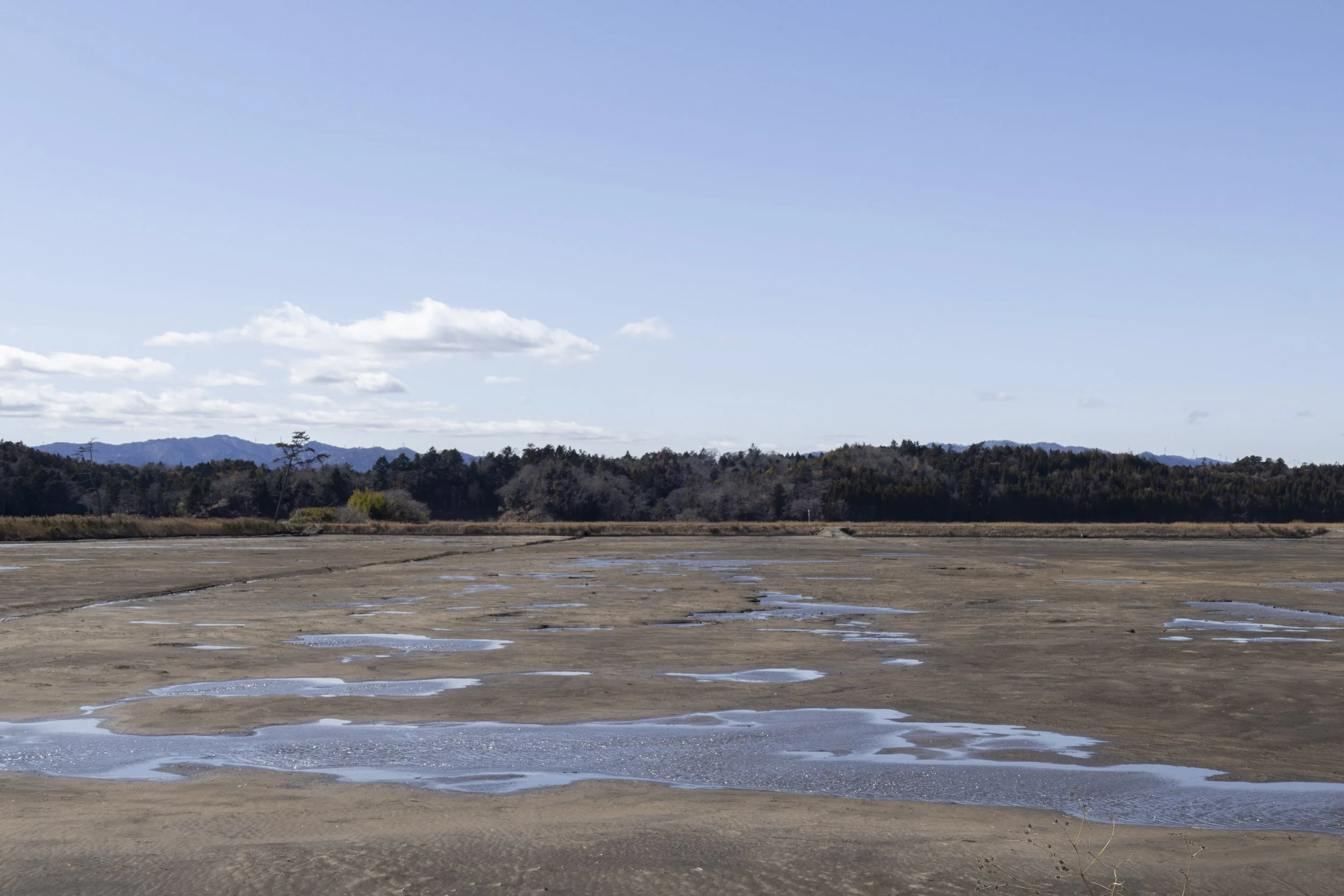
Namie, Fukushima coast area in March, 2026. Where a seaside community once stood, there is now a barren plain. Photo by Thomas Shomaker
The City is Burning
While complacency often set in between tsunamis, fire–as a danger, concept, and ritual–never strayed far from the Japanese mind. Every year, countless fire festivals are held, some of whose roots stretch back into legendary history, like Kyushu’s Oniyo Fire Festival, said to have originated with the execution of an outlaw by fire during the winter of CE 368.
Conflagrations have remained a constant danger over Japan’s history due to its windy weather, seismic activity, warfare, and traditional reliance on wood as its primary construction material. But it was during the Edo period, as Japan’s major cities swelled to the hundreds of thousands, that fires began generating industrial-scale body counts, spurring the government to modernize fire fighting and prevention. In 1648, the Edo Shogunate directed neighborhoods to organize nighttime fire patrols, both to spot developing conflagrations and to catch would-be arsonists. 1650 saw the creation of the world’s first permanent firefighting service, the Jobikeshi.
It was around this time that authorities began chanting Hi na youjin! (Beware of fire!) on their rounds while rhythmically beating wooden clappers. These chants spread across the country, becoming a ritual usually performed in December when fire danger increases. “Beware of fire!” chants eventually developed verses particular to their times, reminding people to dispose of cigarettes properly, check that stoves are turned off, and to be careful with matches. Now performed mainly by local neighborhood children's associations, they remain a common December event in Japanese towns.
But these efforts weren’t enough to prevent Edo’s 1657’s Great Fire of Meireki, begun when a supposedly cursed kimono burning in an exorcism escaped in strong winds. The resulting three-day blaze tore through Edo’s narrow streets and was immediately followed by a blizzard, resulting in an estimated loss of over 100,000 people, roughly 25% of the city’s population.
The devastation prompted the Shogunate to advance fire-prevention measures, mandating wide avenues dividing clusters of narrow blocks as part of Edo’s reconstruction plan, a design still apparent in Tokyo today. The Jobikeshi were divided into brigades paired with volunteer neighborhood firefighting organizations, and, by the 1730s, there were more than 11,000 firefighters throughout Edo. These groups developed increasingly sophisticated techniques, such as isolating budding fires by immediately destroying adjacent buildings, sometimes allowing the flames to advance in the wind’s direction along a narrow path so a line of destruction–rather than a fan–would be the more palatable result.
But the devastation of fires was countered by the speed of reconstruction, a phenomenon noticed even by early Western visitors. In 1878, when Japan’s opening under the Meiji restoration was only a decade old, English writer Isabella L. Bird traveled to a small town, where a recent fire had consumed around 70 houses–as well as the lodge where she had planned on staying. She noted that although the fire happened only a few hours before, “already skeletons of new houses were rising.”
But as far as the Japanese had progressed in disaster awareness and prevention from the Edo period through the 1800s, little could prepare them for the destruction of the 20th century.
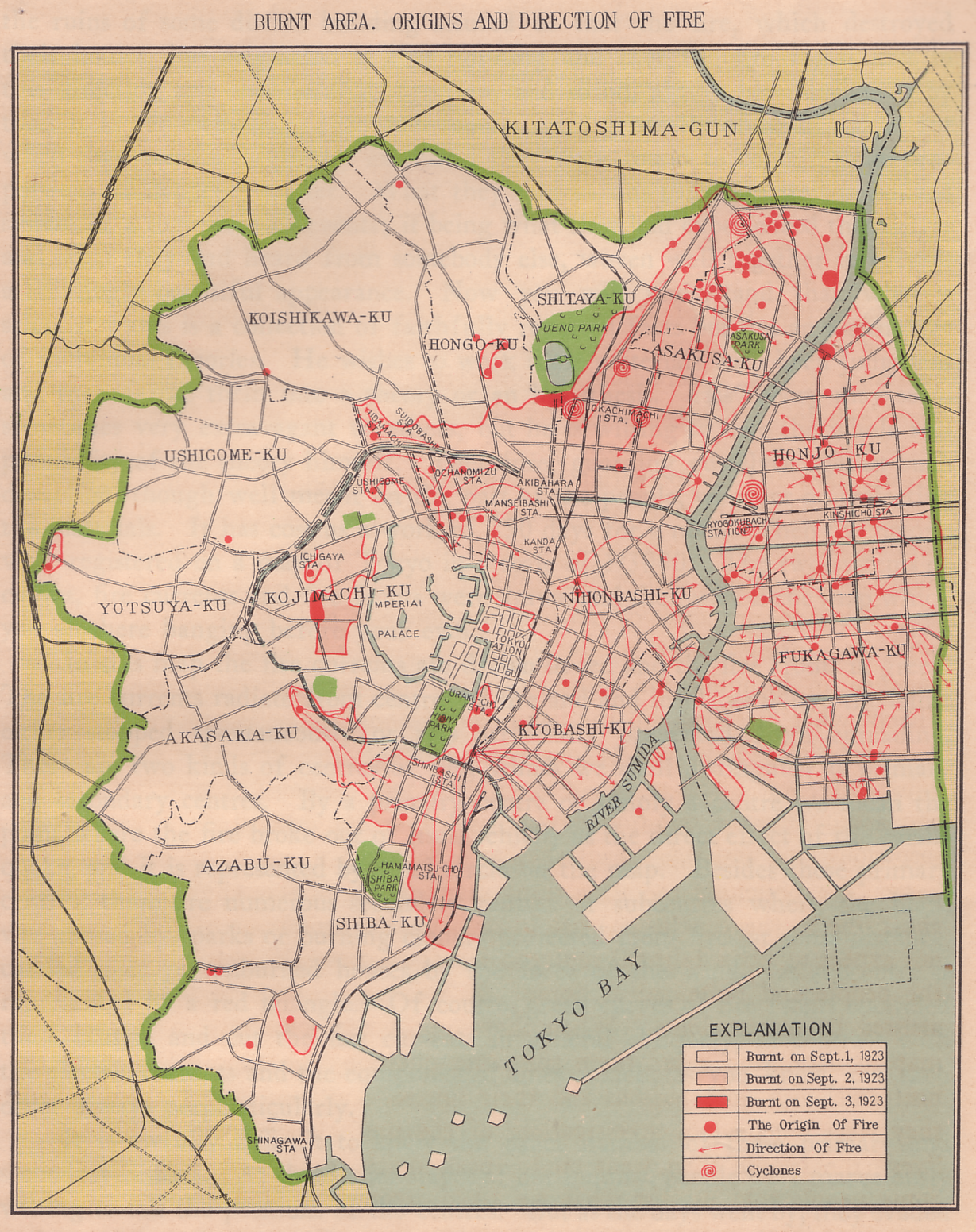
Map from the Mainichi Shimbun newspaper depicting the burnt areas of Tokyo after the Great Kanto Earthquake
Modern Era Devastation
In 1871, Osaka began manufacturing coal gas for lighting, a practice which soon spread to other cities, eventually transitioning into gas mains for cooking and heating. The modern utility, though, created the devastating fires in both the 1923 Great Kanto Earthquake in Tokyo and the Great Hanshin Earthquake, which ravaged Kobe in 1995. Striking at midday and in the early morning, respectively, both quakes ruptured gas lines as many were preparing meals. In 1923, the resulting firestorm destroyed about half of Tokyo and almost all of Yokohama, with about 105,000 fatalities. In Kobe, 72 years later, over 6,000 lost their lives, with many elders remarking that they hadn’t seen such destruction since the war.
The incendiary bombings of World War II, for that matter, kicked off in February 1945 with limited raids on Kobe and Tokyo. Then came Operation Meetinghouse over the night of March 9-10th, in which 279 bombers blanketed the capital with napalm cluster munitions. Tokyo was still a city of predominantly wooden and paper homes, and the small fires from thousands of jellied petroleum bomblets rendered its Great Fire of Meireki-inspired wide avenues ineffective. 41 square kilometers of the central city were leveled in one night, with an official fatality count of around 100,000, although some calculations put the toll twice as high.
As with the impact of gas lines 22 years earlier, modernity created new dangers. Brett Frisk, co-founder of a bilingual archive on Japanese air raids, includes in his translated collection of stories, “The Tokyo Air Raids in the Words of Those Who Survived,” an account of Kikukawa Elementary School–a rare concrete building designed as an evacuation shelter. But the intensity of the surrounding fire turned the structure into an oven, and those searching for survivors the following day only found bones, ash, and belt buckles.
But while the scale of Japan’s 20th-century disasters were supercharged by modern industry and warfare, the recoveries remained remarkably fast. Tokyo, destroyed in 1923 and 1945, welcomed the world when it hosted the 1964 Olympics. The aftermath of 1995’s Kobe Earthquake saw the establishment of the Central Disaster Management Council, founded to improve national and local disaster response coordination, as well as implement stricter building codes and retrofittings of older structures. Most obvious to people’s daily lives was the establishment of Japan’s Earthquake Early Warning system, launched by the Japan Meteorological Agency in October, 2007. The service, first appearing via TV and radio before spreading to smartphones, often issues warnings before tremors begin, giving people vital moments to escape outside or take shelter.
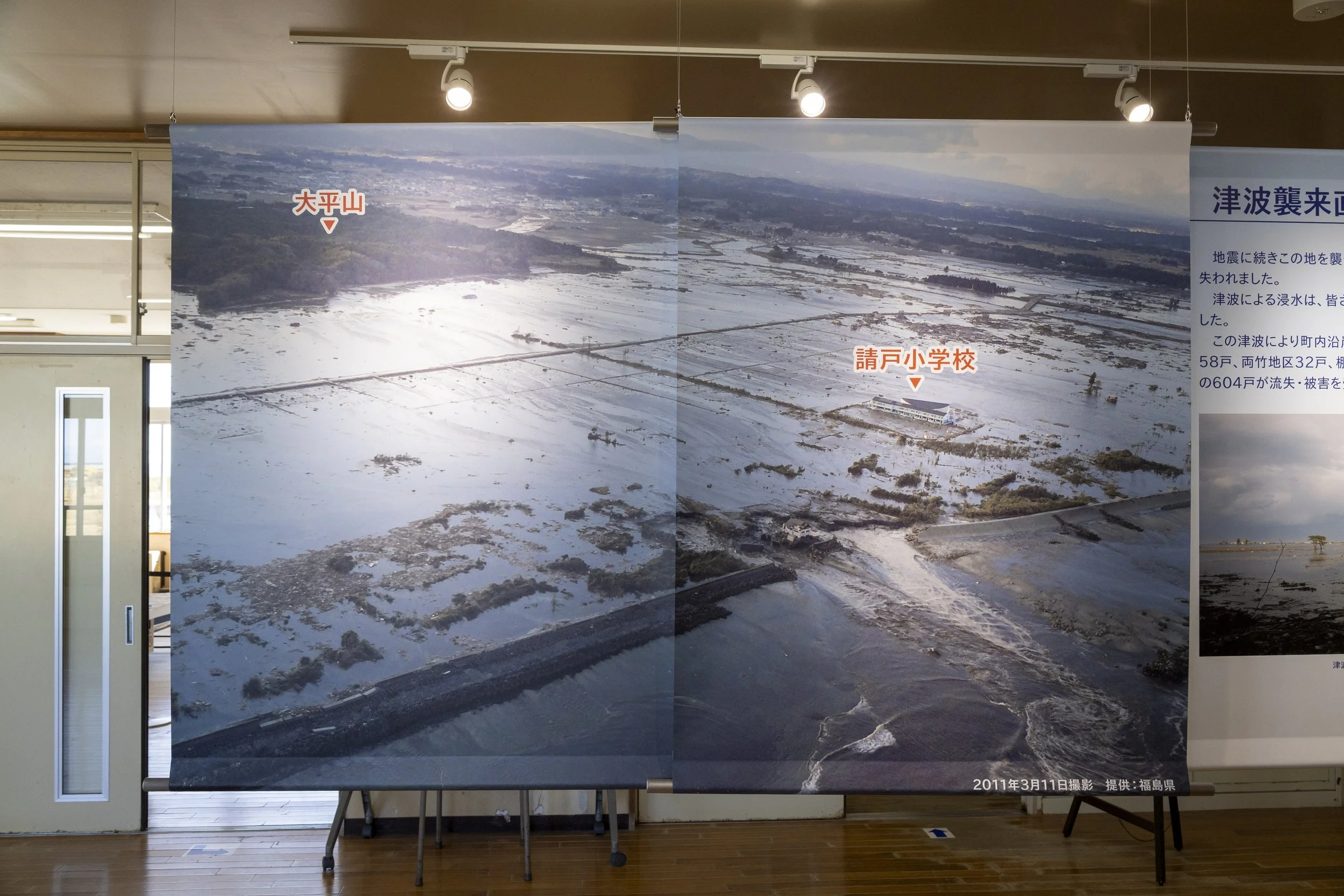
Photo display in the Ukedo Elementary School Memorial Museum depicting the school's location and the evacuation zone of Mt. Ohira. Display photo taken in the immediate aftermath of the tsunami. Photo by Thomas Shomaker
Natural Disaster in the 21st Century
Including the confirmed dead and missing, over 22,000 people were lost during the devastating earthquake and tsunami of 2011. And modernity again amplified the disaster, with the concurrent triple reactor meltdown of the Fukushima Daiichi Power Plant coupled with the wake of the destruction. But most experts agree that, if not for Japan’s sophisticated warning system, the toll would have been far higher. Consider that about the same number of people were killed by the tsunami of 1896 when the country’s total population was around 38.5 million, compared to almost 128 million in 2011.
And despite devastating losses, Japan’s incremental development of disaster responses paid off. All students and staff of the now-memorialized Ukedo Elementary School escaped to the safety of its designated evacuation zone, nearby Mt. Ohira, before the tsunami struck. In the 15 years since, municipalities across Japan have revamped their tsunami preparations. For instance, Wakayama Prefecture’s coastal Tanabe City decided in 2017 to move its city hall from the seaside to a hilltop further inland, and also constructed new 11-meter tsunami evacuation towers, replacing older 7.8-meter structures. Again, Japan was modifying from experience, making small tweaks that may prove vital for future survival.
What is different, though, is that until recently, virtually all Japanese disasters occurred during eras of rising population. The areas devastated in 2011 were already experiencing decline, and, while the government is spending massive amounts to incentivize revival and bolster tsunami defenses, it remains to be seen how a Japan of declining birthrates redevelops after such a disaster.
But what is clear is that the scale of 2011 demarcated a turning point in the modern Japanese psyche. A January 2026 Japanese Red Cross Society survey of 1,200 people nationwide found that over 80 percent believe another 2011-scale disaster is likely in the near future. And in March, Sendai’s Tohoku University launched the world’s first Disaster Science Course. Sooner or later, the ruins of Ukedo Elementary School–whether surrounded by a rebuilt community or still on a barren plain–will again be inundated by the sea. And for now, no one is forgetting it.
About the Author: Thomas Shomaker is an American journalist and documentary film producer. His reporting from and articles about Japan have appeared in Nikkei Asia, the energy trade publication Japan NRG, Powderlife Magazine, and Wine Enthusiast. He has also worked with Tokyo’s Aoyama Gakuin University’s Digital Media Department, producing Japanese and English video stories about their archiving efforts in collaboration with Washington D.C.’s Folger Shakespeare Library. A short documentary Thomas produced about Japan’s Obon Festival was recently part of a global Buddhism exhibit at the Übersee Museum in Bremen, Germany. He lives with his wife and their two children in Kansai’s Wakayama Prefecture.

Recommended Reads
Discover Cultural Experiences


Get right next to the action and observe an authentic sumo training session